
Rebecca K Hodder, Steve McDonald, Anneliese Synnot, Tanya Millard, James Thomas, Miranda Cumpston, Tari Turner
Key Points:
|
Cite this chapter as: Hodder RK, McDonald S, Synnot A, Millard T, Thomas J, Cumpston M, Turner T. Chapter 21: Living systematic reviews. In: Higgins JP, Thomas J, Chandler J, Cumpston M, Li T, Page MJ, et al, editor(s). Cochrane Handbook for Systematic Reviews of Interventions Version 6.5.1 Cochrane, 2026. Available from https://www.cochrane.org/handbook.
21.1 Introduction
21.1.1 Definition of an LSR
A living systematic review (LSR) is “a systematic review that is continually updated, incorporating relevant new evidence as it becomes available” (p.24) (Elliott et al 2017). To support this, searches for new evidence are run frequently, and relevant new information is included in the review periodically so that the findings remain current (Elliott et al 2017). Advice differs on the minimum frequency for searches for a living systematic review. While any threshold is arbitrary, in general searches should be run at least once every three months, with monthly updates being common. The chosen interval should match the pace at which new research is emerging in a particular review topic area. If searches are required less frequently, a living approach may not be appropriate. A living systematic review approach can be applied to either a new or existing systematic review.
21.1.2 History of LSRs
The concept of a living systematic review was first proposed in 2014 (Elliott et al 2014), with initial pilots conducted between 2015 and 2018 by Cochrane (Hodder et al 2024; Millard et al 2019) and others (Synnot et al 2021). The COVID-19 pandemic saw a rapid uptick in living systematic review production (Qingyong et al 2022).
Evaluation of Cochrane’s pilot showed that the production and publication of LSRs was feasible and acceptable to authors, editors, and peer reviewers (Millard et al 2019). Subsequent evaluations of LSRs have shown that the publication of updates after the initial review is particularly challenging, with a substantial proportion of LSRs having no, or delayed, updates for multiple reasons including loss of funding, waning commitment, and the burden of screening search results (Akl et al 2023; De Silva et al 2025; Heron et al 2023; Nevill et al 2025). This highlights the need for careful planning and assessment of resources before starting an LSR.
21.2 Planning a living systematic review
21.2.1 When to do a living systematic review
The decision to start an LSR should be guided by four criteria, three relating to the review topic (drawn from Garner et al 2016) and one relating to feasibility. Given that producing and maintaining an LSR can be a resource-intensive undertaking, all four criteria should be met before an LSR proceeds. Where any are not met, a standard systematic review with less frequent updates may be more appropriate.
- The review question is a priority for decision-making.
Resources are best invested where there is an identified need for updated evidence to inform decision-making by clinicians, policy makers, or people with lived experience. A range of sources of information can be used to identify important questions, including communication from policy and clinical organizations (via informal discussions, strategic or policy documents, or a direct commission for a living review), formal priority-setting exercises (see Chapter 2 (Section ‘Ensuring the review addresses the right questions’)), or the citations and other related usage statistics for existing systematic reviews addressing the same or similar questions. Ideally, the importance of the question would lead to the LSR being linked to living recommendations, living guidelines, policy statements, or other active approaches to translating the results of the review into practice and policy.
- Uncertainty exists.
An LSR is only likely to be useful when the current body of evidence is uncertain and the answer to the review question is not settled. Uncertainty in Cochrane reviews is often indicated by the GRADE assessment of review outcomes (see Chapter 14). Review conclusions with a high level of certainty are unlikely to change with new evidence. Uncertainty in the existing evidence may also exist due to an absence of good-quality systematic reviews on the question of interest, gaps in the primary evidence, or changes in the topic area such as the introduction of new interventions, or changes in the epidemiology or context of a condition.
- New research evidence is likely to be included.
An LSR is appropriate when the research field is moving quickly and new evidence is likely to impact on review conclusions. Activities such as scoping searches, checking clinical trial registries, examining conference proceedings, and corresponding with researchers working in the field of interest may inform judgements about the pipeline of studies in the field.
- Conducting an LSR is feasible for the review team.
In addition to the usual resources required to produce a systematic review (see Chapter II (Section ‘Identifying resources and support’)), LSRs require a sustained commitment for the period that the review remains living. As such, important considerations regarding the feasibility of maintaining an LSR include whether the author team has the capacity, skill, resources, and motivation to sustain an ongoing LSR commitment (acknowledging that the author team may evolve over time).
Prompts for authors to consider when evaluating whether an LSR is feasible in their current circumstances are provided in Box 21.2.a.
Box 21.2.a. Prompts for authors evaluating whether an LSR is feasible
|
21.2.2 Determining appropriate cycles of search, screen, and incorporation
The frequency with which new evidence should be sought for each LSR should be determined by considering the needs of decision-makers, the expected frequency of publication of new evidence, and feasibility. LSRs commonly use a monthly review cycle, but this varies according to the needs of each project.
In each cycle, based on either an updated search or accumulated surveillance, newly identified studies are screened for eligibility. A decision is made about whether to proceed to data collection and incorporate the new studies into an updated version of the review. This is most often based on the likelihood that incorporating new evidence will modify the conclusions of the review, or the certainty of the evidence. The decision to update the review may be informed by estimates of the likely impact, formal statistical tests, or external factors such as the publication of a high-profile study in the field or the feasibility of completing an update at a given time. As such, data collection, analysis, and publication of an update may not be required in each cycle. Figure 21.2.a provides an LSR workflow diagram which illustrates the decision-making process.
Figure 21.2.a. LSR workflow diagram a
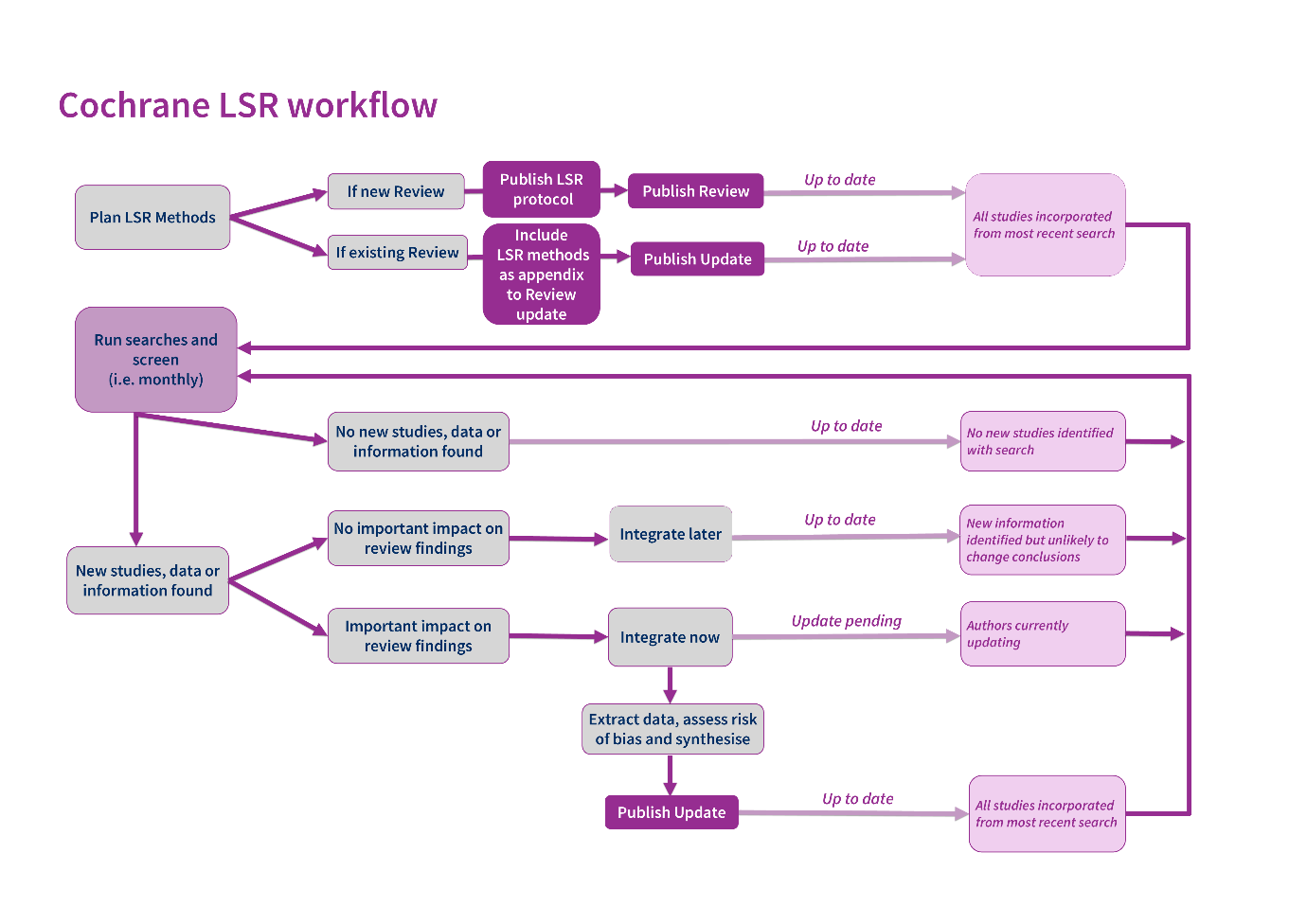
a Figure included from Brooker et al 2019.
21.2.3 Preparing an LSR protocol
An LSR protocol is a living document which will need updates throughout the review’s lifespan. Whether a review is starting out as an LSR or is transitioning into an LSR, the LSR methods should be available in the public domain prior to the process commencing (Butler et al 2024).
A protocol for an LSR should include all information that is required for any systematic review protocol, with some additional methods. The specific methods requirements unique to LSRs are described in detail in Section 21.3.
LSR protocols should be registered (e.g. in PROSPERO (Schiavo 2019)). Publishing a more detailed protocol in a public repository such as the Open Science Framework (OSF (Foster and Deardorff 2017)) or a preprint server allows for ongoing revisions and version control throughout the LSR’s lifespan in parallel to published versions of the review. This offers an advantage over publishing in traditional journals, where updates are less flexible and versioning is not typically supported. Before starting an update, authors should document and justify changes to the protocol in a table, including any changes to the review questions, scope, or the types of evidence used. More information about publication and reporting of LSRs according to PRISMA-LSR is in Section 21.4.
21.2.4 Publishing LSR methods
The approach to publishing the planned LSR methods varies depending on whether the LSR is a new review or an existing review being transitioned into living mode.
For new reviews:
- Authors incorporate the planned LSR methods into the protocol for the review.
- The protocol is published according to standard processes, including peer review.
For existing reviews:
- Authors should liaise with and seek endorsement from journal editorial teams regarding the planned LSR methods before updating the review.
- The LSR-specific methods are integrated in the main text and can be included as an appendix to the review (see example of a ‘Living Systematic Review Protocol’ (Brooker et al 2019)).
21.3 LSR methods considerations
The key differences between LSRs and standard reviews include a priori consideration of how frequently new evidence is sought, screened, and incorporated into the review; how review status updates will be communicated; and when other methods or content in the review will be reviewed.
21.3.1 Searching and evidence surveillance
21.3.1.1 Frequency of searches
Ongoing evidence surveillance ensures reviews can be updated as new research emerges that impacts on review conclusions (see also Chapter 22 (Section ‘22.2.2 Searching for eligible studies’)). The frequency of surveillance searches typically follows a fixed or prespecified interval (e.g. monthly or quarterly), but may also be in response to predefined triggers, such as the publication of a major study.
Advice differs on the minimum frequency for searches for a living systematic review. While any threshold is arbitrary and the interval should be chosen to match the pace at which new research emerges, in general searches should be run at least once every three months. If searches are required less frequently for a particular review topic, a living approach may not be appropriate. In a survey of LSRs that followed a fixed-interval schedule of updating, the median planned period between updates was three months, implying that surveillance searches were at least as frequent (Akl et al 2023).
The initial selection of a fixed-interval frequency is likely guided by the same four criteria used to decide whether to initiate an LSR and can change over time. Searches for COVID-19 living systematic reviews during the early part of the COVID-19 pandemic were updated weekly or monthly but became less frequent as the evidence stabilized (De Silva et al 2025). For example, in an LSR of facial masks for prevention of SARS-CoV-2 in health care and community settings, search frequency switched from monthly to two-monthly and finally to six-monthly before the review transitioned out of living mode (Chou and Dana 2023). Whatever search frequency authors choose must be clearly reported in the methods of the review and updated whenever the frequency is revised.
21.3.1.2 Revision of search methods
A benefit of LSRs is that search methods (i.e. sources searched, search strategies, frequency) can be reviewed regularly to ensure they remain optimal. The search summary table is one technique that can help determine which search methods are most effective (Bethel et al 2021). Recording the contributions made by individual databases or other sources (citation searching, handsearching, grey literature) to unique identification of eligible studies might result in some sources being searched less frequently (e.g. from quarterly to yearly) or being dropped altogether (Lindson et al 2024).
Reviewing the search methods at least annually (or when a new version is published) also ensures that any new database keywords (e.g. the yearly update to the Medical Subject Headings (MeSH) for MEDLINE) or revised search filters are reflected in the search strategy. Changes to the review's eligibility criteria, such as inclusion of additional interventions or the exclusion of specific study types, should prompt immediate consideration of changes to the search strategy. A feature of some COVID-19 living reviews was the shift over time with respect to eligible study designs: many reviews initially included non-randomized studies before limiting to randomized trials (Iannizzi et al 2023). Where eligibility criteria are expanded, it may be necessary to run retrospective searches to ensure all potential evidence from previous years has been retrieved. Regularly checking the search process, including the search strategy, helps optimize the performance of the search (Butler et al 2024).
21.3.1.3 Practicalities of managing ongoing searches
Living reviews that follow a prespecified interval schedule can take advantage of database auto-alerts, whereby saved searches are re-run and users notified of newly identified records. In PubMed, updates of new search results can be emailed daily, weekly, or monthly. Similarly, the Ovid platform enables alerts to be run whenever the database is updated, or on a weekly, monthly, or quarterly basis, depending on the update frequency of the database.
Running regular searches across multiple databases, downloading records, and deduplicating results can of course take considerable resources. Due to the fragmented nature of our database ecosystem – being composed of commercially siloed repositories that do not support automated or open Application Programming Interface (API) searches – progress towards automating this process has been slow. However, there are suggestions that for some purposes, completely open databases such as PubMed and OpenAlex provide sufficient coverage to replace multiple searches of ‘closed access’ databases (Rajit et al 2025). These open access resources may lack sophisticated search functionality, however, which may either result in additional workload when selecting studies (see below), or necessitate the use of machine learning to deal with a higher volume of records (Marshall et al 2020; Shemilt et al 2021). While progress is being made in this fast-evolving field, commercial publishers are removing abstracts that were previously available from open access databases, making automated and open approaches more challenging to implement than might otherwise be the case.
How new records from ongoing searches are managed will depend on the preference of the person responsible. Many information specialists maintain a library of retrieved references over the lifespan of the review to organize records before screening. For example, an EndNote or Zotero library created to organize citations for the initial version of the review will have new citations added for each subsequent update search. The benefit of this approach is that duplicates can be removed, whether detected against the current or previous searches, and the unique contribution of each source can be monitored.
One consideration is how to report updated searches in the review, particularly via the PRISMA flow diagram. A survey of living reviews identified six different ways the study flow diagram was reported in living reviews and proposed four approaches, some more intricate than others (Kahale et al 2021). Templates for these LSR-tailored flow diagrams are available in the data supplement to the PRISMA-LSR extension reporting guideline (Akl et al 2024). More information regarding the PRISMA-LSR extension reporting guidelines can be found in Section 21.4.
The choice of approach to reporting results of updated searches will be determined by what is least cumbersome to maintain and clearest to communicate. An approach increasingly adopted by Cochrane living reviews is to present the search results from the latest update version (i.e. number of records identified, screened, assessed, etc.) separately from the combined number of studies included in all previous versions. For example, in the living Cochrane review of electronic cigarettes for smoking cessation, eligible reports and studies identified by the update search are categorized (new studies, new ongoing studies, reports linked to existing studies, and studies awaiting classification) and feed into the new combined totals for the number of included and ongoing studies (Lindson et al 2024).
Information about how readers can be kept informed of studies identified between published updates is found in Section 21.4.1.
21.3.2 Selecting studies
LSRs follow the same core methods for screening search records as standard reviews (see Chapter 4 (Section ‘Selecting studies’)), although the frequency of the screening will reflect the frequency of searching. When screening the results of update searches, it is important that new reports of studies already included in the review are linked and not inadvertently treated as new studies. The issue of multiple reports is likely to be common in LSRs where, over the life of the review, studies may appear first as trial register entries, then in other forms (protocols, conference abstracts, preprints) before their eventual publication.
The increased frequency of screening and selecting studies for LSRs can be resource intensive. An expanding range of software and tools has been developed to assist with managing and automating the selection of studies for systematic reviews, and these may be particularly useful for reducing the workload involved in LSRs (see Chapter 4 (Section ‘Software support for selecting studies’)). This includes machine learning models or ‘classifiers’, such as the ‘RCT Classifier’, which identifies randomized trials; Cochrane Crowd, a citizen science platform where contributors identify and describe studies; or screening workflows such as Screen4Me that combines the use of the RCT Classifier and Cochrane Crowd (Noel-Storr et al 2021).
An opportunity afforded by LSRs, as opposed to conventional systematic reviews, is the use of review-specific supervised machine learning classifiers that can be continually trained and refined based on the screening decisions from the initial review and subsequent updates (Bannach-Brown et al 2019). LSRs can be a viable context for automation because, once the baseline review has been completed, a dataset which accurately describes the scope of the review has been created: this is an ideal scenario for developing, validating, and using machine learning. For example, using title and abstract data from the baseline study selection process (i.e. those records identified as eligible versus ineligible after full-text screening), it is possible to build a machine learning classifier that can predict eligibility for subsequent updates. Such a classifier can be designed to achieve high recall (i.e. sensitivity) and eliminate clearly irrelevant records automatically. Furthermore, the recent developments in large language models (LLMs) offer potentially significant workload savings (Homiar et al 2025). Rather than building a machine learning model, authors write ‘prompts’ that enable the LLM to specify whether a study is eligible or not. Given the data available in the baseline review, these prompts can be built and validated for use in subsequent updates. Following good information retrieval practice, the records used to build and test prompts should not then be used for validation (Callaghan et al 2025; Homiar et al 2025; Shemilt et al 2024; Shemilt et al 2025).
The extent to which such tools meaningfully reduce workload largely depends on the number of records that ongoing searches generate at each update. For LSRs with relatively few records to screen at each update, the time and effort required to build a machine learning model, or to develop prompts, may not be worthwhile or worth the potential risk of missing relevant records. However, in situations where automated database searching can be combined with automated first-pass screening, more benefit may accrue. Moreover, potential benefits from technology automation need not stop there, with automated identification of full-text reports and subsequent full-text screening now being implemented in some LSR workflows. Finally, automated data extraction is also being evaluated for use in LSRs thanks to the presence of validation data from the baseline review (Khan et al 2024). As with standard reviews, the planned use of software and automation tools in LSRs should be stated a priori in systematic review protocols and registration (e.g. PROSPERO) and follow the Responsible use of AI in evidence SynthEsis (RAISE) guidance (Thomas et al 2025a, 2025b, 2025c).
At the time of writing, there is very little empirically evaluated software available for study selection that is entirely automated and does not require review author input. Evaluations, such as there are, tend to be quite small-scale, and use different models on different datasets, so it is difficult to draw generalizable conclusions. To address this, Shemilt and colleagues have advanced the idea of a prospective ‘living study within a review’ (or ‘living SWAR’). The aim here is to use essentially the same process and methods to evaluate LLMs for screening in order to generate a more cumulative evidence base (Shemilt et al 2024). The few tools that are in use tend to be in situations where software developers can create custom tools and workflows for specific LSRs. Thus, for the time being, for LSRs where review authors are required to screen records more frequently, but are not working with a data science team, efficiency may be improved by ensuring the same authors screen and select studies for a predetermined period of time (e.g. screen results from each monthly search for six months).
21.3.3 Collecting data and considering bias among included studies
LSRs follow the same core methods for collecting data and considering and assessing risk of bias as standard reviews (see Chapter 5; Chapter 7; Chapter 8). For LSRs, data collection and risk of bias assessment is ideally conducted as new evidence is identified, which can be more frequent than standard reviews (i.e. if regular searches identify new evidence).
A number of semi-automated and automated data extraction tools developed to improve the efficiency and accuracy of standard reviews may also be particularly enabling for data extraction and assessing risk of bias in LSRs (Schmidt et al 2025). At the time of writing, however, no tools have been rigorously evaluated for fully automating data extraction for systematic reviews from full texts or assessing risk of bias. Evaluations of semi-automated tools have been conducted, which combine automated data extraction with manual data extraction by review authors and could be considered for adoption for LSRs (see Chapter 5 (Section ‘Automating data extraction in systematic reviews’)). Similarly, semi-automated risk of bias tools have been developed that use machine learning models that both predict risk of bias and extract supporting text from full texts (Arno et al 2022).
21.3.4 Preparing for synthesis
LSRs follow the same core methods for summarizing study characteristics and preparing for synthesis as standard reviews (see Chapter 9), with the additional consideration for LSRs of when to incorporate new evidence.
It is often not feasible to republish LSRs at the same frequency that searches are conducted, nor is this required if no new studies are identified. Decisions around when to incorporate new evidence into an LSR should take into consideration the rate at which new evidence is accumulating. In LSRs where a high volume of new evidence is anticipated, a prespecified interval schedule to updating can be adopted (e.g. every three months, as with Cochrane pilot LSRs). However, LSRs are typically updated when new evidence is identified that is likely to impact the review conclusions.
Two key decisions are needed to determine whether new evidence will substantively affect the conclusions of an LSR. The first is whether formal statistical methods will be used to predict whether new evidence will affect the LSR conclusions (e.g. based on study size or the effect estimate), the alternative being to extract and incorporate new data routinely and re-run the data analysis to directly determine whether the LSR conclusions have changed. The second decision pertains to what type or degree of change in LSR conclusions is sufficiently important to warrant publication of an updated version of the LSR. Such thresholds should ideally be specified a priori. Numerical thresholds, such as change in effect size or precision of effect size estimates, may vary by outcome and will depend on minimum clinically important differences. Other factors to consider include a change in the direction of effect, the certainty in the effect (e.g. assessed using GRADE, see Chapter 14), or the introduction of previously unreported interventions, populations, or serious adverse events.
Further guidance regarding methods for determining whether new evidence may impact the conclusions of an existing systematic review can be found in Chapter IV, Chapter 22, and an article by Garner and colleagues (Garner et al 2016). Chapter 22 provides an overview of the Framework for Adaptive Meta-analysis (FAME) (Rydzewska et al 2017, Tierney et al 2017). FAME considers all relevant trials, including those for which results are not yet available, and uses trial information to predict when a reliable aggregate data meta-analysis will be possible.
21.3.5 Analysing data and undertaking meta-analysis
LSRs follow the same core methods for analysing data and undertaking meta-analyses as standard reviews (see Chapter 10). However, the increased frequency of identifying and synthesizing evidence in updated meta-analyses can also raise concerns around multiple testing (Section 21.3.5.1). Existing methods for conducting meta-analyses have been applied for use with LSRs, including living network meta-analysis (Section 21.3.5.2).
21.3.5.1 Adjustment for multiple testing
The increased frequency of identifying and incorporating new evidence for LSRs typically involves updating previous meta-analyses to calculate new intervention effects and confidence intervals. It has been suggested that an adjustment to account for the increased risk of type I errors in LSRs due to repeated meta-analyses may be required. A variety of methods for reducing the risk of type I and type II errors have been developed that can be adopted in repeated meta-analyses for LSRs (Simmonds et al 2017). These issues are discussed in Chapter 10, ‘Statistical issues arising from repeating meta-analyses’. It has been argued that LSRs typically do not require such adjustment due to their inherently prospective nature (Nikolakopoulou 2024). However, adjustment might be considered if updates or stopping of the review are dependent on meta-analysis results (Nikolakopoulou et al 2024).
21.3.5.2 Living network meta-analysis
Network meta-analysis (NMA) is a technique for comparing three or more interventions simultaneously in a single analysis by combining both direct and indirect evidence across a network of studies (Chapter 11). A ‘living’ network meta-analysis adopts the same methodology as an NMA, but adopts more frequent searching and incorporation of evidence as it is identified. Living network meta-analyses of prospectively planned randomized trials have been found to produce stronger evidence up to four years earlier than pairwise meta-analysis methods (Nikolakopoulou et al 2018; Rouse et al 2016).
21.3.6 Periodic review of the appropriateness of LSR and methods
After an LSR has been in living mode for 12 months, a review of various aspects of the review methods is recommended. First, authors should consider whether the review still meets the criteria for an LSR and importantly whether there are sufficient resources to continue to maintain the review in living mode (see Section 21.2.1). Second, authors should review the appropriateness of the core and LSR-specific methods. This includes reviewing the search methods (see Section 21.3.1), the frequency of synthesizing new research evidence, and the availability of any new methods, statistical techniques, or technology enablers that could be used.
21.4 Reporting requirements for LSRs
LSR protocols and completed versions of the review should explicitly describe aspects of the methods unique to LSRs, in addition to the other methods required for any systematic review (see Chapter III). PRISMA-LSR, a PRISMA extension for LSRs, outlines the additional reporting requirements for LSRs (Akl et al 2024) (see PRISMA-LSR checklist). Authors should also consider reporting information in protocols regarding when LSR methods will become active (e.g. after the initial completion or update of the review), and how and where the results of the evidence surveillance or updating will be shared between updated versions of the LSR. Additional information regarding reporting LSR search updates in PRISMA-LSR flow diagrams is covered in Section 21.3.1.3.
21.4.1 Communicating the status of living systematic reviews between updates
To achieve their intended purpose, it is essential that the status of LSRs, including information about any new studies identified since the last published update, is communicated to readers. This is especially important when search results are screened more regularly than the review is updated. Although authors may establish explicit trigger(s) for publishing an update, readers should be informed of whether new studies have triggered the preparation of a new version (Metzendorfet al 2023). Therefore, author teams must plan how to share review status, search results, and update intentions between publications, and inform readers where to access this information.
To address this, some living reviews make the results of the surveillance searches publicly accessible. Authors of the Cochrane living review of nirmatrelvir combined with ritonavir for preventing and treating COVID-19 maintained a spreadsheet on the Open Science Framework that detailed the search and study selection process, enabling readers to track the progress of eligible ongoing or completed studies (Reis et al 2023). Similarly, for the living review of e-cigarettes, a publicly available spreadsheet provides information on eligible studies identified each month and indicates whether the study report is linked to an existing study or represents a new study (https://www.cebm.ox.ac.uk/research/electronic-cigarettes-for-smoking-cessation-cochrane-living-systematic-review-1).
21.4.2 Publishing initial and updated LSRs
It is essential that authors collaborate with journal editorial teams before embarking on an LSR to ensure editorial workflows can facilitate the more frequent publication. An adapted editorial and publication workflow was developed as part of a successful pilot project in 2017 for Cochrane LSRs (Millard et al 2019). A large number of LSRs have been published in the Cochrane Library, of which many continue to be maintained as LSRs. Many other journals across a broad spectrum of topic areas have similarly adapted their workflows and publish LSRs, including the BMJ, BMJ Open, Annals of Internal Medicine, Systematic Reviews (BMC), Journal of Clinical Epidemiology, and PLoS Medicine.
Author teams seeking to embark on a Cochrane LSR are required to follow the established process for Cochrane reviews, including submission of a title registration form, and development and publication of a protocol describing LSR methods prior to commencing the LSR. The title registration form requires an explicit statement of the intention for the review to be an LSR, justification of why it needs to be living, the intended search and synthesis frequency, and the team capacity for continuous updating.
21.4.3 Transitioning an LSR out of living mode
It is likely that ongoing continual updating of some LSRs, or particular review questions, will eventually become inappropriate. The reasons or triggers for why an LSR may be transitioned out of living mode should be predetermined and specified in the protocol where possible. For example, the review question may no longer meet the four criteria listed in Section 21.2.1. The appropriateness of continuing to maintain the LSR should be reviewed on an annual basis (see Section 21.3.6) or occur in the context of priority-setting activities. Factors that could be examined include article-level metrics for the LSR (e.g. Altmetrics, downloads, citations); knowledge translation activities arising from an LSR, including impact on policy and practice; and new research initiated.
As with starting an LSR, deciding when to stop maintaining a review in living mode requires consideration by the authors and the relevant journal editorial team, and pre-specification. It is recommended that the author and relevant editorial teams make a pre-planned transition out of living mode such that one final update can be undertaken to include any new evidence found since the last update and modify or remove text regarding LSR methods (see Box 21.4.a Modifications required for final published update of retired LSRs). Readers should also be informed that the systematic review is no longer in living mode.
Box 21.4.a. Modifications required for final published update of retired LSRs
| Section | Modifications |
| Abstract, plain language summary, and background | Modify these to indicate that the review was previously an LSR, the LSR timeframe, and why the review was transitioned out of living mode. |
| Background | Remove text about the rationale for an LSR approach or any secondary objective to maintain the review as an LSR. |
| Methods | Search methods: Remove text about ongoing evidence surveillance (e.g. monthly database and clinical trial registries searches; conference abstracts) from the ‘Electronic searches’ and ‘Searching other resources’ subsections. Selection of studies: Remove text about screening the ongoing searches. Data synthesis: Remove LSR-specific text (e.g. immediately extracting and analysing data after screening the monthly searches). Methods for future updates: Remove any LSR-specific text about reviewing the methods, or the conditions under which the review will no longer be maintained as an LSR. |
| Differences between protocol and review | For an LSR that was transitioned from a standard review to an LSR, this section can be adjusted to reflect the transition back to a standard review. For an LSR that commenced as a new review following publication of an LSR protocol, this section will need to be modified to reflect that the review has been transitioned out of living mode. |
| Appendices | For an LSR that was transitioned from a standard Cochrane review to an LSR, the LSR-specific methods appendix can be removed. (For readers wanting to access the LSR methods, a link can be provided to the most recent version of the review that included these methods.) |
21.4.4 Authorship and maintaining the author team
While LSRs follow the same authorship guidelines as standard reviews, they present unique challenges to managing authorship. For example, the evaluation of Cochrane pilot LSRs found that, due to the quick turnaround required and number of contributors available, some authors of earlier versions of the LSR were either unavailable to contribute to core review tasks for subsequent updates, or there was very little review work to be done (Millard et al 2019). For many LSRs, it is likely that the relative contributions of authors will vary across versions of an LSR. Therefore, it is expected that the author team will evolve over time.
It is strongly recommended that LSR teams discuss authorship management as early as possible and establish expectations and criteria for authorship. These criteria should be consistent with good academic practice (such as the International Committee of Medical Journal Editors (ICMJE) criteria, see Chapter II (Section ‘Criteria for authorship’)). It is important that authors understand how the publication of multiple versions of an LSR is related to publication metrics, such as number of citations per publication. Depending on the journal or other publication platform, each update of an LSR may be regarded as an individual publication with a unique DOI. While this results in an increased number of publications for authors, the number of citations for an LSR is spread across all versions, thereby reducing the number of citations per individual publication.
21.5 Chapter information
Authors: Rebecca K Hodder, Steve McDonald, Anneliese Synnot, Tanya Millard, James Thomas, Miranda Cumpston, Tari Turner
Funding: RKH is supported by an NHMRC Early Career Fellowship (APP1160419).
Declarations of interest: The authors have no conflicts of interest to declare.
21.6 References
Akl EA, El Khoury R, Khamis AM, El Mikati IK, Pardo-Hernandez H, Farran S, et al. The life and death of living systematic reviews: a methodological survey. Journal of Clinical Epidemiology 2023; 156: 11-21. doi:10.1016/j.jclinepi.2023.02.005
Akl EA, Khabsa J, Iannizzi C, Piechotta V, Kahale LA, Barker JM, et al. Extension of the PRISMA 2020 statement for living systematic reviews (PRISMA-LSR): checklist and explanation. BMJ 2024; 387: e079183. doi:10.1136/bmj-2024-079183
Arno A, Thomas J, Wallace B, Marshall IJ, McKenzie JE, Elliott JH. Accuracy and efficiency of machine learning-assisted risk-of-bias assessments in "real-world" systematic reviews : a noninferiority randomized controlled trial. Annals of Internal Medicine 2022;175(7):1001-9. doi: 10.7326/M22-0092
Bannach-Brown A, Przybyła P, Thomas J, Rice ASC, Ananiadou S, Liao J, et al. Machine learning algorithms for systematic review: reducing workload in a preclinical review of animal studies and reducing human screening error. Systematic Reviews 2019; 8(1): 23. doi:10.1186/s13643-019-0942-7
Bethel AC, Rogers M, Abbott R. Use of a search summary table to improve systematic review search methods, results, and efficiency. Journal of the Medical Library Association2021; 109(1): 97-106. doi:10.5195/jmla.2021.809
Brooker J, Synnott A, McDonald S, Elliott JH, Turner T, Hodder RK, et al. Guidance for the production and publication of Cochrane living systematic reviews: Cochrane Reviews in living mode 2019. Retrieved from https://community.cochrane.org/sites/default/files/uploads/inline-files/Transform/201912_LSR_Revised_Guidance.pdf
Butler AR, Hartmann-Boyce J, Livingstone-Banks J, Turner T, Lindson N. Optimizing process and methods for a living systematic review: 30 search updates and three review updates later. Journal of Clinical Epidemiology 2024; 166: 111231. doi:10.1016/j.jclinepi.2023.111231
Callaghan M, Banisch L, Doebbeling-Hildebrandt N, Edmondson D, Flachsland C, Lamb WF, et al. Machine learning map of climate policy literature reveals disparities between scientific attention, policy density, and emissions. npj Climate Action 2025; 4(1): 7. doi:10.1038/s44168-024-00196-0
Chou R, Dana T. Major Update: Masks for Prevention of SARS-CoV-2 in Health Care and Community Settings-Final Update of a Living, Rapid Review. Annals of Internal Medicine 2023; 176(6): 827-35. doi:10.7326/m23-0570
De Silva K, Turner T, McDonald S. Cochrane's COVID-19 living systematic reviews: a mixed-methods study of their conduct, reporting and currency. Cochrane Evidence Synthesis and Methods 2025; 3: e70024.
Elliott J.H, Synnot A, Turner T, Simmonds M, Akl EA, McDonald S, et al. Living systematic review: 1. Introduction—the why, what, when, and how. Journal of Clinical Epidemiology 2017; 91: 23-30. doi:10.1016/j.jclinepi.2017.08.010
Elliott JH, Turner T, Clavisi O, Thomas J, Higgins JP, Mavergames C, et al. Living systematic reviews: an emerging opportunity to narrow the evidence-practice gap. PLoS Medicine 2014; 11(2): e1001603. doi:10.1371/journal.pmed.1001603
Foster ED, Deardorff A. Open Science Framework (OSF). Journal of the Medical Library Association 2017; 105(2): 203-6.
Garner P, Hopewell S, Chandler J, MacLehose H, Schünemann HJ, Akl EA, et al. When and how to update systematic reviews: consensus and checklist. BMJ 2016; 354: i3507. doi:10.1136/bmj.i3507
Heron L, Buitrago-Garcia D, Ipekci AM, Baumann R, Imeri H, Salanti Get al. How to update a living systematic review and keep it alive during a pandemic: a practical guide. Systematic Reviews 2023; 12(1): 156. doi:10.1186/s13643-023-02325-y
Hodder RK, O'Brien KM, Wyse RJ, Tzelepis F, Yoong S, Stacey FG, et al. Interventions for increasing fruit and vegetable consumption in children aged five years and under. Cochrane Database of Systematic Reviews 2024; 9. doi:10.1002/14651858.CD008552.pub8
Homiar A, Thomas J, Ostinelli EG, Kennett J, Friedrich C, Cuijpers P, et al. The development and evaluation of prompts for a large language model to screen titles and abstracts in a living systematic review. BMJ Mental Health 2025; 28(1):e301762. doi: 10.1136/bmjment-2025-301762
Iannizzi C, Chai KL, Piechotta V, Valk SJ, Kimber C, Monsef I, et al. Convalescent plasma for people with COVID-19: a living systematic review. Cochrane Database of Systematic Reviews 2023; 5. doi:10.1002/14651858.CD013600.pub6
Kahale LA, Elkhoury R, El Mikati I, Pardo-Hernandez H, Khamis AM, Schünemann HJ, et al. Tailored PRISMA 2020 flow diagrams for living systematic reviews: a methodological survey and a proposal. F1000Res 2021; 10: 192. doi:10.12688/f1000research.51723.3
Khan MA, Ayub U, Naqvi SAA, Khakwani KZR, Sipra ZBR, Raina A et al. Collaborative Large Language Models for Automated Data Extraction in Living Systematic Reviews. medRxiv 2024. doi:10.1101/2024.09.20.24314108
Lindson N, Butler AR, McRobbie H, Bullen C, Hajek P, Begh R,et al.Electronic cigarettes for smoking cessation. Cochrane Database of Systematic Reviews 2024; 1. doi:10.1002/14651858.CD010216.pub8
Marshall IJ, Nye B, Kuiper J, Noel-Storr A, Marshall R, Maclean R, et al.Trialstreamer: A living, automatically updated database of clinical trial reports. Journal of the American Medical Informatics Association 2020; 27(12): 1903-12. doi:10.1093/jamia/ocaa163
Metzendorf MI, Weibel S, Reis S, McDonald S. Pragmatic and open science-based solution to a current problem in the reporting of living systematic reviews. BMJ Evidence Based Medicine 2023; 28(4): 267-72. doi:10.1136/bmjebm-2022-112019
Millard T, Synnot A, Elliott J, Green S, McDonald S, Turner T. Feasibility and acceptability of living systematic reviews: results from a mixed-methods evaluation. Systematic Reviews 2019; 8(1): 325. doi:10.1186/s13643-019-1248-5
Nevill CR, Sharifan A, O'Mahony A, Tahir H, Robinson W, Modha U, et al. Capturing the influx of living systematic reviews: a systematic methodological survey. Journal of Clinical Epidemiology 2025, 186. doi:10.1016/j.jclinepi.2025.111904
Nikolakopoulou A, Mavridis D, Furukawa TA, Cipriani A, Tricco AC., Straus SE, et al. Living network meta-analysis compared with pairwise meta-analysis in comparative effectiveness research: empirical study. BMJ 2018; 360: k585. doi:10.1136/bmj.k585
Nikolakopoulou A, Schwarzer G, Siemens W. To adjust or not to adjust in living systematic reviews? It’s all about the context. Zeitschrift für Evidenz, Fortbildung und Qualität im Gesundheitswesen 2024; 187: 95-9. doi:https://doi.org/10.1016/j.zefq.2024.04.001
Noel-Storr A, Dooley G, Affengruber L, Gartlehner G. Citation screening using crowdsourcing and machine learning produced accurate results: Evaluation of Cochrane's modified Screen4Me service. J Clin Epidemiol 2021; 130: 23-31. doi:10.1016/j.jclinepi.2020.09.024
Qingyong Z, Jianguo X, Ya G, Ming L, Luying C, Lu X, et al. Past, present and future of living systematic review: a bibliometrics analysis. BMJ Global Health 2022; 7(10): e009378. doi:10.1136/bmjgh-2022-009378
Rajit D, McDonald S, Tay CT, Du L, Enticott J, Teede H. Assessing the coverage of PubMed, Embase, OpenAlex, and Semantic Scholar for automated single-database searches in living guideline evidence surveillance: a case study of the international polycystic ovary syndrome guidelines 2023. Journal of Clinical Epidemiology 2025; 183: 111789. doi:10.1016/j.jclinepi.2025.111789
Reis S, Metzendorf MI, Kuehn R, Popp M, Gagyor I, Kranke P,et al.. Nirmatrelvir combined with ritonavir for preventing and treating COVID-19. Cochrane Database of Systematic Reviews 2023; 11. doi:10.1002/14651858.CD015395.pub3
Rouse B, Cipriani A, Shi Q, Coleman AL, Dickersin K, Li T. Network Meta-analysis for Clinical Practice Guidelines: A Case Study on First-Line Medical Therapies for Primary Open-Angle Glaucoma. Annals of Internal Medicine 2016; 164(10): 674-82. doi:10.7326/m15-2367
Rydzewska LHM, Burdett S, Vale CL, Clarke NW, Fizazi K, Kheoh T, et al. Adding abiraterone to androgen deprivation therapy in men with metastatic hormone-sensitive prostate cancer: a systematic review and meta-analysis. European Journal of Cancer. 2017;84:88-101.
Schiavo JH. PROSPERO: An International Register of Systematic Review Protocols. Med Ref Serv Q 2019; 38(2): 171-80. doi:10.1080/02763869.2019.1588072
Schmidt L, Finnerty Mutlu A, Elmore R, Olorisade B, Thomas J, Higgins J. Data extraction methods for systematic review (semi)automation: Update of a living systematic review [version 3; peer review: 3 approved]. F1000Research 2025; 10(401). doi:10.12688/f1000research.51117.3
Shemilt I, Hollands G, Khouja C, Raine G, Kneale D, O’Mara-Eves A, et al. Generative Large Language Model-Based Tools for Health and Social Care Applications: A Living Map and Critical Review (Protocol). In. London: EPPI Centre, Social Science Research Unit, UCL Institute of Education, University College London, 2024.
Shemilt I, Thomas J, Churchill R, Finnerty Mutlu A, Graziosi S, Khouja C, et al. Generative Artificial Intelligence Tools versus Conventional Screening by Humans for Selecting Eligible Study Reports for Evidence Synthesis: A Living Study within a Review (SWAR). Open Science Framework 2025. doi:https://doi.org/10.17605/OSF.IO/G7MKB
Shemilt I, Arno A, Thomas J, Lorenc T, Khouja C, Raine G, et al. Cost-effectiveness of Microsoft Academic Graph with machine learning for automated study identification in a living map of coronavirus disease 2019 (COVID-19) research. Wellcome Open Research 2021; 6: 210. doi:10.12688/wellcomeopenres.17141.2
Simmonds M, Salanti G, McKenzie J, Elliott J, Agoritsas T, Hilton J, et al. Living systematic reviews: 3. Statistical methods for updating meta-analyses. Journal of Clinical Epidemiology 2017; 91: 38-46. doi:https://doi.org/10.1016/j.jclinepi.2017.08.008
Synnot A, Gruen RL, Menon D, Steyerberg EW, Buki A, Peul WC, et al). A New Approach to Evidence Synthesis in Traumatic Brain Injury: A Living Systematic Review. Journal of Neurotrauma 2021; 38(8): 1069-71. doi:10.1089/neu.2015.4124
Thomas J, Flemyng E, Noel-Storr A, et al. Responsible AI in Evidence Synthesis (RAISE) 1: Recommendations for practice. In Open Science Framework [https://osf.io/] 2025a. Washington DC: Center for Open Science.
Thomas J, Flemyng E, Noel-Storr A, et al. Responsible use of AI in evidence SynthEsis (RAISE) 2: Building and evaluating AI evidence synthesis tools. In: Open Science Framework. Center for Open Science 2025b.
Thomas J, Flemyng E, Noel-Storr A, et al. Responsible use of AI in evidence SynthEsis (RAISE) 3: Selecting and using AI evidence synthesis tools. In: Open Science Framework. Center for Open Science 2025c.
Tierney J, Vale C, Burdett S, Fisher D, Rydzewska L, Parmar MKB, editors. Timely and reliable evaluation of the effects of interventions: a framework for adaptive meta-analysis (FAME). Society for Clinical Trials Annual Meeting; 2017; Liverpool, UK.


