

For more than 30 years, Cochrane has championed the involvement of patients and the public in shaping health evidence, and this commitment remains just as strong today.
Recently, we have begun to look more closely at how we can translate our commitment to patient and public involvement (PPI) into a serious ambition.
We know that there is always room for improvement. The world needs answers to an increasingly diverse range of questions, and we need to keep those affected by different and emerging health challenges at the forefront of the evidence synthesis we produce. In 2025, we took significant steps to embed PPI more deeply into our work.
Where are we now?
In our reviews
In 2024, we introduced a required ‘Consumer Involvement’ reporting section for authors. ‘Consumers’ may include researchers, health care providers, patients and members of the public, or other professionals, such as policy makers or commissioners.
This allows us to understand how patients and the public are being involved in our reviews. And we have really seen the impact.
Amongst those reporting on Consumer Involvement, approximately 17% of published reviews and 37% of published protocols in 2025 included PPI. This is our baseline measurement. It is the first time we’ve asked authors to report on this aspect of their research. For some, it may have been the first time they considered involvement at all. While the figures are modest, the percentage of people involved in protocols is promising because it suggests future growth: as these protocols progress to reviews, we expect involvement to increase.
Among the reviews that involved patients and the public, some stand out for the depth and quality. These examples show what’s possible when authors work closely with those impacted to shape research questions, interpret findings, and ensure relevance. We caught up with Alex and Ailsa to hear more about how they embedded involvement in their reviews:
“By involving people who use nicotine vapes and healthcare professionals, we ensure our research addresses real concerns such as how to quit vaping safely without increasing the risk of returning to smoking. [...] In response to feedback we use the term ‘vape’ instead of ‘e-cigarettes’ in our title and have added important outcomes to the review.” Ailsa Butler, author of two Cochrane reviews on vaping and e-cigarettes
“I think that the changes introduced as a result of consumer involvement makes our review much more clinically relevant, and therefore easier to interpret and apply to clinical decision-making.
The framework for describing physical rehabilitation interventions, co-developed with the consumers, informed our analyses which, in turn, provided evidence that one particular approach [...] might be less effective than other ways of delivering physical rehabilitation.” Alex Todhunter-Brown, author of a Cochrane review on physical rehabilitation approaches for the recovery of function and mobility following stroke
Through introducing this reporting, and initiatives like the ACTIVE framework and the Involving People training, we’ll continue supporting authors and patients and the public to make involvement a standard part of the process.
We are also continuing to expand our training offers by supporting PPI training more widely. For example, with Cochrane Ireland on their ‘Getting Involved in Health Research Reviews: A Course for the Public’. In 2025, this free, 6-week course was delivered to over 18 global patients and members of the public, building their knowledge and skills to contribute meaningfully to health research review teams.
We also involve patients and the public in peer review. In 2025, 100% of manuscripts first submitted to the Cochrane Database of Systematic Reviews were sent to a patient and public reviewer for their opinion when they were sent for peer review. Feedback from patients and the public is important to make sure that Cochrane reviews are easy to understand, written in plain language and relevant and sensitive to patients' needs. Of those invited to give their opinion, 64% contributed to patient and public peer review.
Outside reviews
Beyond the writing of our reviews, we have been collaborating to encourage public involvement. For example, in November Cochrane teams worked together to involve patients and the public in a campaign to promote new evidence about on the HPV vaccine.
We also started a series of interviews with people who have been involved with Cochrane, and Cochrane Groups who are involving patients and the public. We hope this allows people to see the ways you can get involved with Cochrane and demonstrates the value PPI can bring to our work.
Finally, we have grown our Patient and Public Network by a record-breaking 13% in 2025, with more than half of new members joining from low- and middle-income countries. Today, our Network includes over 2,850 individuals from around the world.
Beyond Cochrane
We have been actively involved with ‘The People’s Review’, a first-of-its-kind project where the public can influence all the major steps in a systematic review.
“The People’s Review demonstrates a new way of involving people in evidence synthesis. It widens and democratizes participation, opening the door for the public to help shape the future of health research and strengthen both evidence and practice. This work reflects a growing ambition, shared by Cochrane, to ensure health evidence is shaped with, and by, the people who use it. It has been an absolute joy and privilege to work alongside more than 500 people from 81 countries to bring this collective endeavour to life.” Éle Quinn, Project Lead of The People’s Review, PhD student
We have also continued our support for the GALENOS project – a global initiative producing living systematic reviews on anxiety, depression, and psychosis. Our role in this collaboration was to ensure best practice in involving people with lived and living experience.
This included reviewing processes and making recommendations to strengthen PPI across the project. Our contributions helped refine engagement strategies, improve inclusivity, and ensure that voices of those most affected by mental health conditions were heard and valued.
Where are we going?
We are currently working on a new overarching PPI strategy. This process is being led by our Patient and Public Network Executive and shaped by our global community. We expect this new strategy to reaffirm the importance of PPI across Cochrane, and set a vision for how we can improve involvement in the future.
“Cochrane has a long-standing commitment to working with patients and the public to ensure that its evidence is relevant to their priorities. Today we have begun to look more closely at how we can translate that commitment into a serious ambition. We hope that from there we can continue to make patient and public involvement in the work we do a standard expectation, and not an exception.” Toby Lasserson, Cochrane’s Acting Editor-in-Chief
We are also making a real effort to strengthen our connections with Geographic Groups, listening and working together to advance equality of patient and public representation in reviews.
Cochrane’s Co-production Methods Group is working diligently to strengthen and promote co-production in evidence synthesis, helping to deepen meaningful involvement across Cochrane and beyond.
Join us
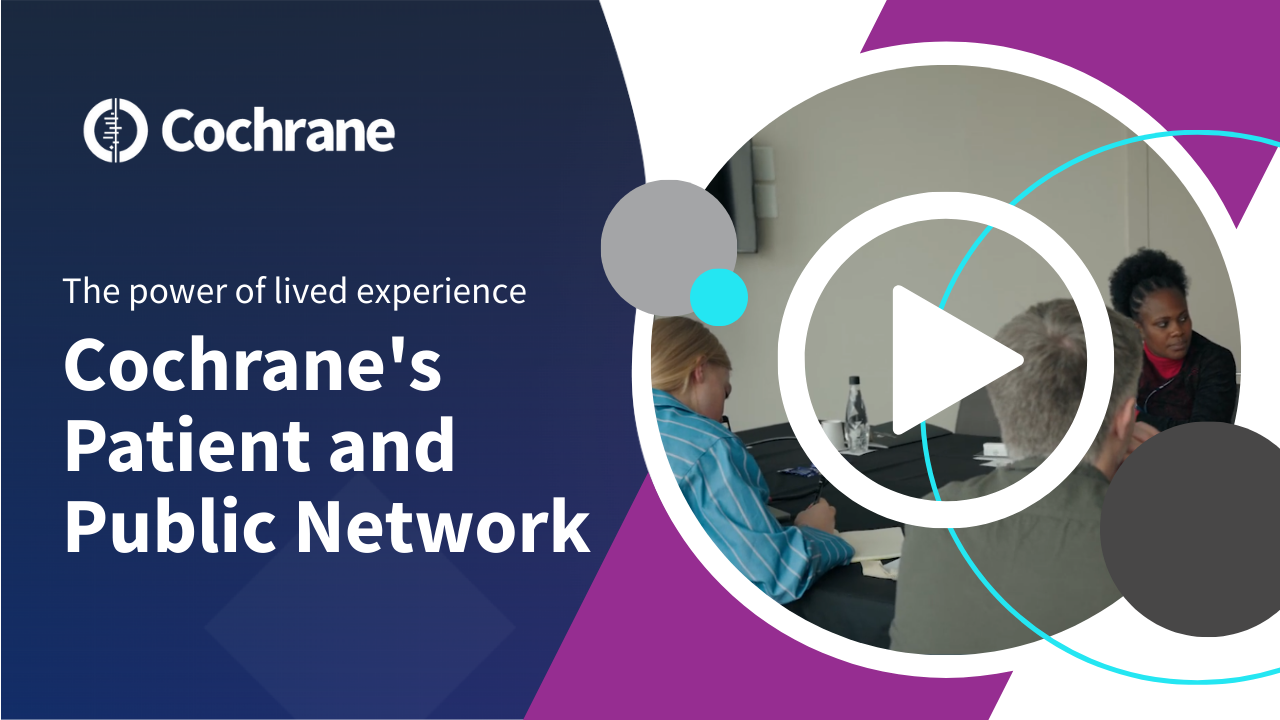
This work isn’t finished, and Cochrane remains committed to PPI. We are always trying to improve – so while we know what we’re doing now isn’t perfect, we are focused on strengthening our PPI work, and continuing to report on it annually. We are committed to continuous listening, learning, and making involvement easier and more accessible for everyone. By embedding patient and public voices in our work, we aim to produce evidence that truly matters.
Finally, we’d like to say thank you to all the people who make this progress possible – everyone who has contributed their lived experiences, the researchers prioritizing PPI and those who are continuing to support PPI and amplify its importance.
If you are interested in getting involved as a patient or member of the public with Cochrane – sign up via our network.
If you are looking to involve patients, check out our Involving People training.


