Cochrane is made up of 13,000 members and over 50,000 supporters come from more than 130 countries, worldwide. Our volunteers and contributors are researchers, health professionals, patients, carers, people passionate about improving health outcomes for everyone, everywhere.
Cochrane is an incredible community of people who all play their part in improving health and healthcare globally. We believe that by putting trusted evidence at the heart of health decisions we can achieve a world of improved health for all.
Many of our contributors are young people working with Cochrane as researchers, citizen scientists, medical students, and volunteer language translators and we want to recognize the work of this generation of contributors as part of this series called, Cochrane’s “30 under 30."
In this series, we will interview 30 young people, 30 years old or younger who are contributing to Cochrane activities in a range of ways, all promoting evidence-informed health decision making across the world.
We will be hearing from them in a series of interviewees published over the coming months.
We're keen to hear from you. Would you like to take part in this series? Do you know someone you'd like to see interviewed? Contact lparsonson@cochrane.org. Or if you want to know more about Cochrane’s work contact membership@cochrane.org where our community support team will be happy to answer your questions.

Name: Norah Essali (on Twitter @norahessali7)
Age: 27
Occupation: Psychiatry Resident
Program: Department of Psychiatry and Health Behavior - Medical College of Georgia
How did you first hear about Cochrane?
I was a medical student when first introduced to Cochrane through the work of my father, Adib Essali. I participated in one of his many workshops in Syria that focused on training medical students, and other healthcare professionals, on the concepts of evidence based medicine, critical appraisal of research and writing Cochrane reviews.
How did you become involved with Cochrane? What is your background?
I first became involved in medical school, when the UK Cochrane centre, directed by Martin Burton, led an initiative to start Students 4 Best Evidence, a global community run by students that aims to engage students in learning about the concepts of evidence based health care.
What do you do in Cochrane?
I was one of the pioneers who helped start students4bestevidence.net while I was in medical school.
I'm also an author in the Cochrane Schizophrenia Group. Currently, I'm working with a group of wonderful, Syrian medical students on 2 systematic reviews.
What specifically do you enjoy about working for Cochrane and what have you learnt?
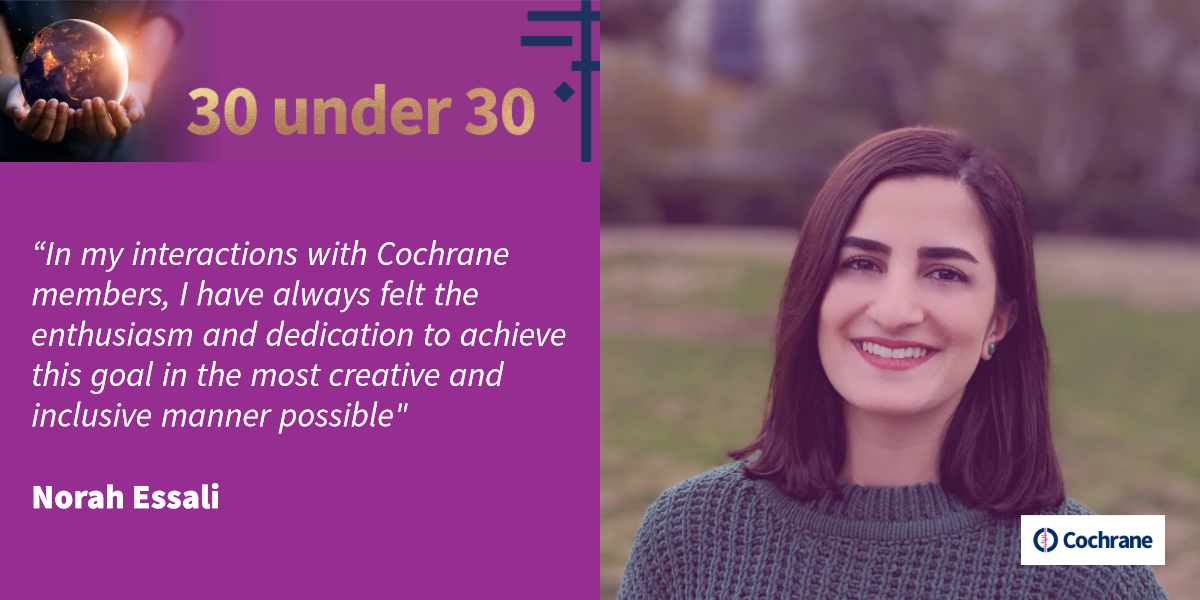
I've enjoyed working for Cochrane because I believe in their message of spreading high quality evidence to inform medical decision making. Additionally, in my interactions with various Cochrane members, I have always felt the enthusiasm and dedication to achieve this goal in the most creative and inclusive manner possible.
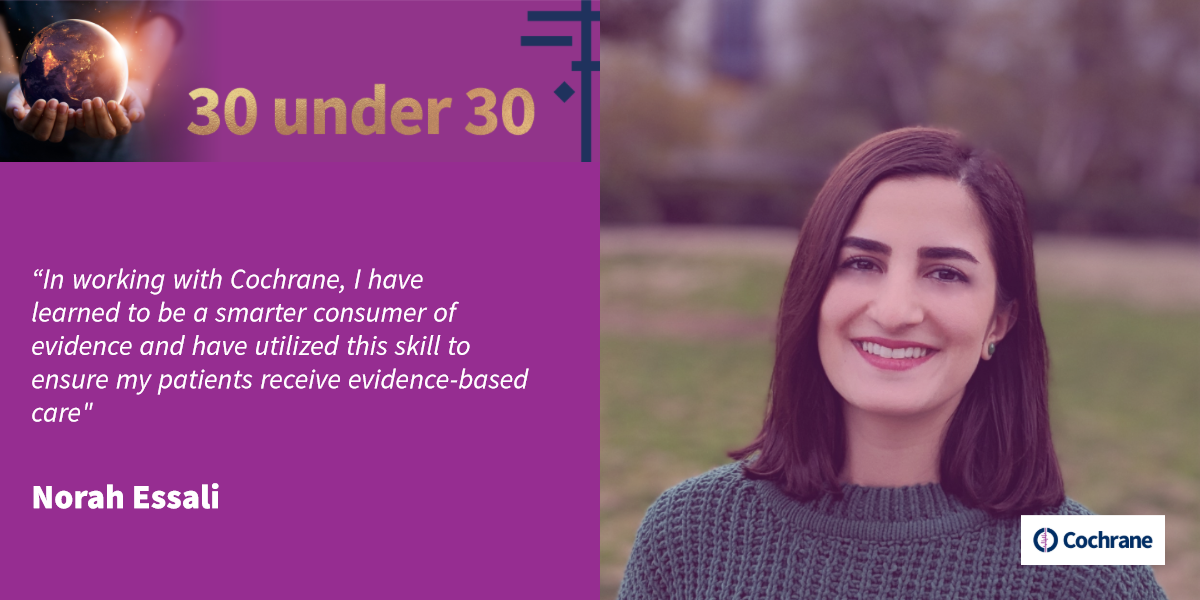
In working with Cochrane, I have learned to be a smarter consumer of evidence and have utilized this skill to ensure my patients receive evidence-based care.
What are your future plans?
I'm currently in training to become a Psychiatrist. I plan to specialize further in Addiction Psychiatry as I'm interested in working with dual diagnosis patients, especially in emergency settings. I also hope to continue to contribute to research in my field.
In your personal experience, what one thing could Cochrane do better to improve its global profile?
I believe that an online initiative to engage students is a wonderful starting point. Cochrane could expand upon this by building curriculums for health sciences schools, worldwide, to utilize in teaching students about EBM.
What do you hope for Cochrane for the future?
My hope is that Cochrane will continue to grow, conflict free, continue to engage young people and continue to produce high quality evidence.
How important is it that young people get involved in Cochrane? Why is this, do you think?
Very important. If evidence-based practice is instilled early on, it will increase the likelihood of producing healthcare professionals that use EBM daily to inform their practice. This will then ensure patients have access to well informed providers and thus the best available care.
What would your message be to other young people who want to get involved with Cochrane’s work but not sure where to start….?
I would highly encourage their interest and recommend they start with students4bestevidence.net to learn about the basic concepts of EBM. Also, go to cochrane.org/join-Cochrane to find out different ways they can get involved with Cochrane, based on their interests.