
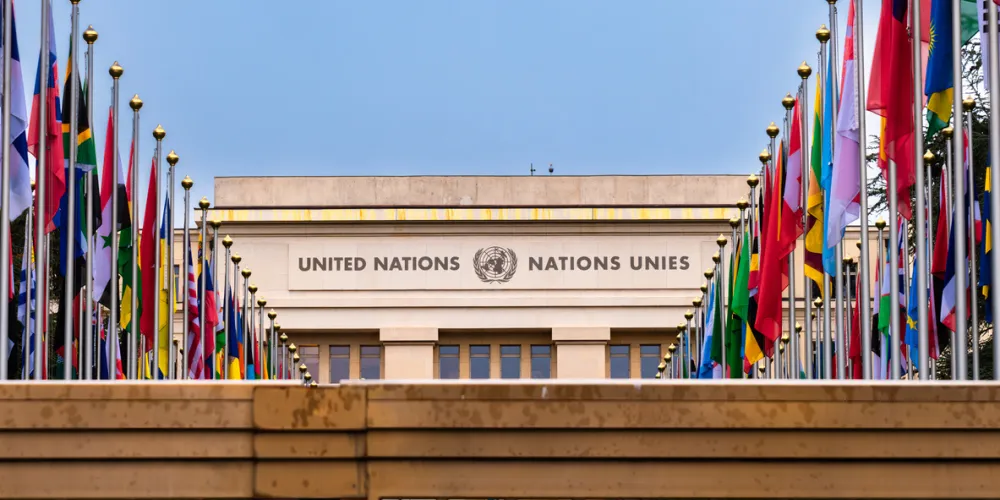
Following a busy week at the 79th World Health Assembly (WHA), we’re reflecting on the inspiring conversations and high-level discussions Cochrane had the privilege of being involved in.
Held at the UN Headquarters in Geneva, the WHA is the decision-making body for the World Health Organization (WHO), attended by representatives of all Member States, as well as non-governmental organizations and funding organizations. Being in official relations with WHO gives Cochrane a stronger platform at WHA to advocate for and contribute evidence, build relationships, and show our value in global health decision-making.
Cochrane’s Chief Executive Officer, Dr Karla Soares-Weiser, was in attendance, participating in three events that were held on the sidelines of WHA.
Governing AI in health
Cochrane participated in a high-profile side event as a Knowledge Partner on the potential and the pitfalls of artificial intelligence, hosted by NIMS University Rajasthan, National University of Singapore, Health Innovation Exchange and the Centre for European Studies (CEPS).
Speaking on the panel “Evidence to Impact: Governing AI in Health,” Cochrane CEO Karla Soares-Weiser highlighted the need for evidence systems to evolve in line with the speed and complexity of decision-making. She emphasized Cochrane’s role in supporting the responsible use of AI in evidence synthesis, including the importance of human oversight, transparency, and trust.
She also underlined the need for meaningful participation from the global majority in shaping this transition, ensuring that AI-enabled health systems are equitable, inclusive, and grounded in the best available evidence.
Strengthening global influence and partnerships
Cochrane also partnered with Devex to host a high-level reception that brought together global health leaders and funders in a more informal setting. We hope that many useful conversations were had.
Driving evidence-informed policy on obesity
Cochrane’s third major engagement was at an official WHA side event focused on obesity prevention and management, hosted by the Ministry of Health, Dominican Republic. Dra Andelys de la Rosa Toribio, Director of Cochrane Dominican Republic, led this event. The panel included Dr. Jarbas Barbosa, Director for the Americas PAHO/WHO, Dr Victor Atallah Minister for Health of the Dominican Republic as well as representatives from health ministries in El Salvador and Panama.
The session addressed obesity as a growing global health challenge, given its links to rising rates of noncommunicable diseases such as diabetes and cardiovascular disease.
Karla Soares-Weiser joined the panel to explore how evidence generation and knowledge translation can impact on public policy and clinical decision-making for obesity. Karla reflected on why evidence matters and what it takes to make it useful. At Cochrane, multiple chronic conditions is one of the four pillars of our scientific strategy. We are working towards making sure evidence can meet decision-makers where they are, supporting real-world implementation in complex systems.
Supporting Cochrane Rehabilitation
Cochrane was also represented inside the Palace of Nations through the work of Cochrane Rehabilitation at a WHA official event integrating rehabilitation for health, longevity, and equity. This was led by Carlotte Kiekens, co-director of Cochrane Rehabilitation.
By engaging with WHO, country delegations, funders, and academic partners, the organization aims to reinforce its role in evidence-to-policy systems and ensure that evidence remains central to global health reform. It is a key forum to advocate for evidence-informed health policies.
For any questions about partnerships, collaborations, or Cochrane’s work at WHA, please contact Claudia Llado, Senior Advisor for External Engagement at partnerships@cochrane.org.


