
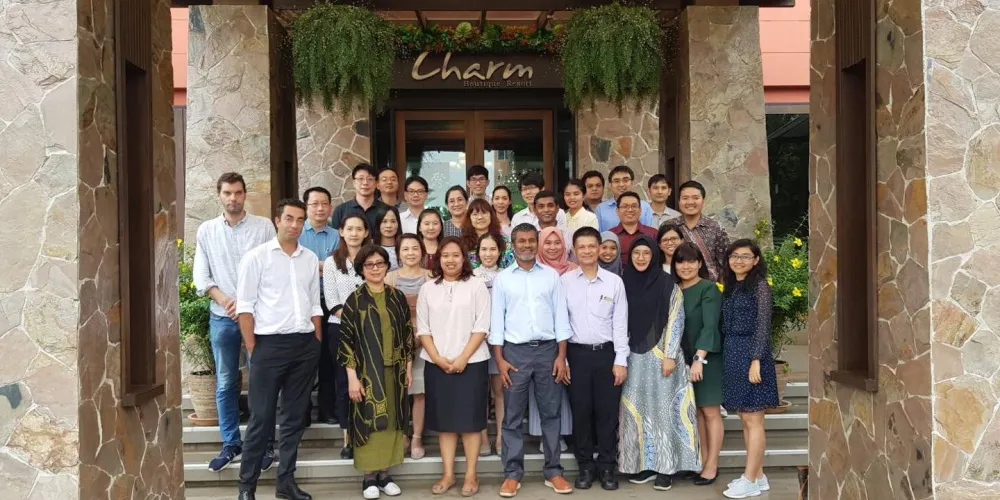
Discover the role Cochrane Thailand has played in closing the gap between evidence and outcomes. Designated as a WHO Collaborating Centre for Research Synthesis in Reproductive Health, the group has not only generated Cochrane reviews but has also translated those findings into national policy and clinical guidelines.
A longstanding partnership
Cochrane Thailand’s relationship with the World Health Organization spans over 30 years. During this time, Cochrane Thailand has produced numerous reviews that have directly informed WHO recommendations, particularly in maternal health. This includes influencing guidelines on maternal infections, preterm birth outcomes and breastfeeding. For example, six reviews produced by Cochrane Thailand are references in the 2015 WHO guideline on prevention and treatment of maternal peripartum infections.
The contribution of Cochrane Thailand also extends beyond evidence synthesis. Members of the group have also been invited to participate in WHO guideline development panels, helping to interpret evidence and shape recommendations. Rather than rewriting entire guidelines every 5 years, WHO now updates specific recommendations as new evidence emerges around specific issues. Members from Cochrane Thailand have participated as a member of WHO guideline development groups in many WHO recommendations. For example, WHO recommendations on intrapartum care for a positive childbirth experience, non-clinical interventions to reduce unnecessary caesarean sections and antibiotic prophylaxis during labour for vaginal birth.
Maternal health – from reviews to roadmaps
The group are also helping the WHO and others to fill gaps in the evidence by producing reviews on areas that are less certain. For example, currently they’re working on a Cochrane review (Surgical techniques for uterine incision in caesarean section) looking at the evidence around caesarean sections alongside Cochrane's Maternal, Newborn and Child Health Thematic Group and WHO.
Previously, the two groups collaborated to support the consolidated WHO postpartum haemorrhage guidelines (PPH) in October 2025, these recommend how to prevent and treat one of the leading causes of maternal death worldwide. The WHO currently defines PPH as losing over ≥500 ml of blood from the genital tract following childbirth, however, this threshold lacks an evidence-based foundation and is inconsistently implemented globally. The WHO recently convened a group of experts to review and update the definition and recommendations for PPH. The experts proposed a definition that incorporates a lower blood loss threshold alongside key clinical signs to help identify PPH cases and trigger treat earlier. As part of this work, Convenor of Cochrane Thailand, Pisake Lumbiganon, was invited to be involved in primary research to evaluate the feasibility and adherence to diagnosing and treating PPH using the newly recommended definition by WHO. The study has been accepted for publication.
Between 2022 and 2024, Pisake initiated the development and dissemination of Asia Oceania Federation of Obstetrics and Gynecology (AOFOG) recommendations across member countries in the region. Building on WHO recommendations, these guidelines address the use of heat-stable carbetocin for the prevention of postpartum haemorrhage (PPH) and the WHO care bundle approach for PPH detection and treatment. As President of the Royal Thai College of Obstetricians and Gynaecologists, Pisake also worked to implement the recommendations into the country, this included convening a meeting with the Thai Ministry of Public Health which led to the production of a Memorandum of Understanding, aiming to adapt the global recommendations to the context of Thailand’s health system.
Eliminating cervical cancer in Thailand
One of the most powerful examples of evidence translated into practice is Thailand’s progress in cervical cancer prevention – a disease that continues to cause more mortality in women across Asia and Africa than maternal death.
More than a decade ago, during a term as President of the Royal Thai College, Convenor Pisake Lumbiganon got the opportunity to meet with Thailand’s Minister of Public Health. This meeting was the start of collaborative work to tackle this preventable disease.
At the time, cervical cancer incidence remained high, and vaccination and screening coverage was inconsistent. In 2020, the age-standardized incidence rate of cervical cancer for Thailand was 16.4 per 100000 with the age-standardized mortality rate of 7.4 per 100000. Drawing on global evidence, Thailand implemented HPV vaccination for girls, HPV DNA screening for women aged 30-60 years and a clear pathway to treat positive cases.
Today, the coverage for HPV vaccination for girls in Thailand is approximately 95 %. However, the HPV DNA screening coverage was about 50 to 60%. There have been challenges – for example, many women remain reluctant or embarrassed to attend screening. At the same time, population mobility, particularly women moving from rural areas to large cities, has complicated access to services linked to local registration. The country now is introducing self‑sampling for HPV DNA testing, adapting interventions to work in people’s lived realities.
The team at Cochrane Thailand believe that as these interventions mature, cervical cancer incidence and mortality in Thailand will continue to decline. This is a demonstration of how evidence, policy, and leadership can combine to produce lasting population level impact.
Evidence, commitment and collaboration
Cochrane Thailand exemplifies what is possible when evidence synthesis, policy engagement, and leadership work together. In cervical cancer elimination, maternal health, and beyond, the group has shown that rigorous evidence paired with collaboration and commitment can save lives and influence health systems.
Discover more about Cochrane ThailandFind out about the latest Cochrane evidence on HPV


