
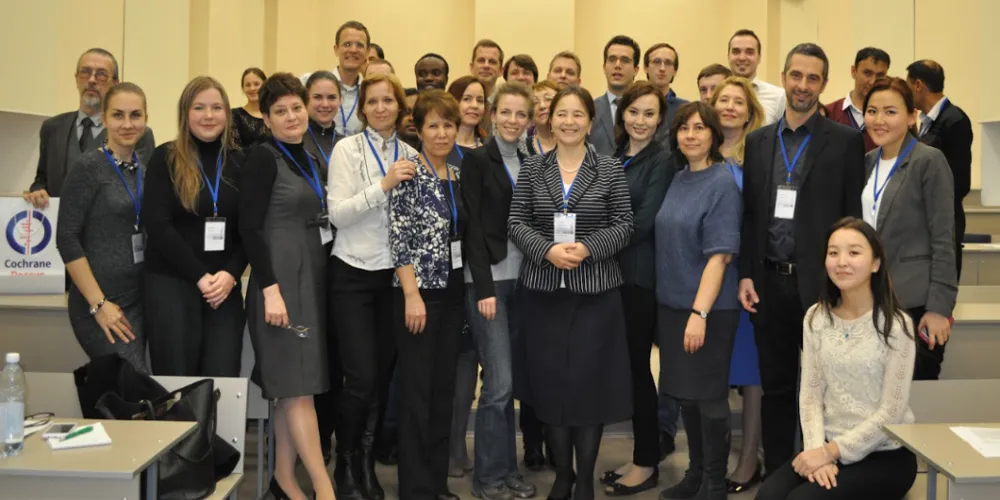
When Cochrane Russia was established in 2015, it began as a coordinating hub for Russia and Russian‑speaking countries. Over the past decade, it has achieved a lot – advancing evidence-based healthcare in a region that's diverse in geography and culture, and has an appetite for trusted knowledge.
A decade of achievements
What started as an part of the Nordic Cochrane Centre has, over the past decade, grown into a vibrant and highly active contributor to Cochrane. Cochrane Russia was launched with an event in December 2015, featuring leaders from Cochrane and the World Health Organization. This set the tone for what followed – a decade of activities to broaden access to evidence-based medicine across the country.
Some of the centre’s successes include:
| Delivering more than 50 face-to-face and virtual training courses and sessions | Presenting Cochrane evidence at over 100 conferences and symposia | Regularly contributing plain language summaries to 5 Russian medical journals |
| Translating nearly 5,000 plain language summaries of Cochrane reviews, thanks to the efforts of over 200 volunteers | Gaining the support of over 7,500 volunteer members and supporters in Russian-speaking countries | Publishing more than 50 articles in the Great Russian Encyclopedia on Cochrane including definitions relating to evidence-based medicine and interventions based on Cochrane evidence |
| Translating the Methodological Expectations of Cochrane Intervention Reviews (MECIR) handbook into Russian | Contributing to over 30 Cochrane reviews and protocols | Translating the Evidence Essentials course into Russian, resulting in over 11,000 views on this course |
The impact of Cochrane Russia’s work was perhaps most visible in early 2020 at the start of the COVID-19 pandemic. Russia became the country that was most frequently accessing Cochrane plain language summaries. The team worked to quickly translate all of the Cochrane Library Special Collections into Russian and deliver these to national health institutions and the Ministry of Health.
Marking a milestone
As the Centre reached its 10-year anniversary, it marked the occasion with a series of major events across Moscow and Kazan in December 2025. These covered topics such as evidence-based clinical practice guidelines for multimorbidity, the use of Cochrane reviews in clinical guideline development, and a School of Evidence-Based Medicine, designed to encourage younger people to get involved with Cochrane’s activities in Russia.
Guest experts travelled from across the globe, including colleagues from Cochrane China and the World Health Organization country office. The events were broadcast across Russia and beyond, with recordings shared widely and warmly received.
One of the celebration’s highlights was an online presentation from Dr Lorenzo Moja of the WHO Essential Medicines List team, offering insights into the latest Essential Medicines List updates, including the implications of new Cochrane reviews on anti-diabetes and anti-obesity medicines.
For the celebration events Cochrane Russia also repeated a survey first carried out in 2015. The respondents analyzed achievements and barriers to evidence-based medicine in their countries, concluding that they were better informed about Cochrane, used Cochrane reviews routinely and would like to work on building Cochrane's presence in their regions.
Facing challenges
Like many Cochrane groups, Cochrane Russia has faced its share of challenges. Among the most persistent has been convincing some institutional leaders of the value of participating in Cochrane despite a lack of material or economic gain. The team strongly believe that Cochrane can help institutions promote values such as research integrity and high-quality health care delivery, and can provide learning opportunities for students.
Support from partners has been crucial for Cochrane Russia’s journey. The WHO’s country office in Moscow publicly reaffirmed its commitment to collaborate on improving national health, while Wiley colleagues, WHO experts, and the International Journal of Risk & Safety in Medicine have all remained key partners.
“Through all these years we have been working and developing Cochrane in Russia with strong central Cochrane support, through the years of pandemic and war, the years of Cochrane Russia moving forward between hosting institutions.
We thank you all heartily for the great strong support and plan further scaled developments of Cochrane Russia.” – Liliya Eugenevna Ziganshina, Cochrane Russia
Looking ahead
Despite these obstacles, Cochrane Russia’s presence in the region is now firmly established. Cochrane reviews are widely used through a national subscription for the Cochrane Library, and the hard work of translation teams making summaries available in Russian. Awareness of Cochrane’s mission has grown steadily, exemplified by the 2025 anniversary survey, which saw double the response rate of 2015, with participants from across Russia, Belarus, Kazakhstan, Kyrgyzstan, Uzbekistan and beyond.
For Cochrane Russia, the next decade holds tremendous potential. Work is already underway to build a broader Cochrane Russia Network. Many supporters have helped sustain its journey through moments of triumph and turbulence alike, and now the message is clear: the first 10 years were only the beginning.


