
Doctors’ prescribing habits are heavily influenced by payments, gifts, and free meals from pharmaceutical companies, leading to more expensive, less appropriate and more drugs being prescribed, a new Cochrane review finds. This can seriously harm both individual patients and health systems.
Pharmaceutical companies use a variety of strategies to market and promote their drugs. This can include one-on-one visits by sales reps to doctors' offices and hospitals, gifts and payments including for example paid meals, travel costs to conferences, entertainment, consulting fees, honoraria for participation in advisory boards, and advertising.
For all new medicines, pharmaceutical companies target prescribers with offers of free meals and other gifts and payments. These payments and gifts lead to prescribing of the company's promoted drug, which may not always be needed or be the most appropriate or affordable medicine for each patient.
Less appropriate prescribing and higher medicine costs
The review included 93 studies involving a number of different study types. Almost all of these studies observed real-world prescribing patterns rather than running controlled experiments. The majority of the studies (88%) came from the United States, in part because the Physician Payments Sunshine Act (2010) requires pharmaceutical companies to publicly report details of all payments to doctors, which are compiled in a publicly searchable and analyzable database.
Analyzing millions of prescribers, the authors grouped industry interactions into three distinct categories to examine how each one affects a doctor's prescribing habits. These were advertising and education, gifts and payments, and free samples. The authors also looked at conflict-of-interest policies as a mitigation strategy.
Advertising and education, such as sales rep visits, seemed linked to prescribing that was less clinically suitable and pricier, with fairly strong evidence that it also drove up prescription volume.
The largest and most consistent body of evidence covered gifts and payments. Gifts and payments were also linked to less appropriate prescribing, more prescriptions, and probably increased costs.
The evidence was too sparse to draw clear conclusions on free drug samples and whether promotion affects hospitals’ approved formularies, although what little exists suggests it might.
Overall, when doctors have more contact with drug company promotion, prescribing tends to become less appropriate, more frequent, and more expensive.
– Dr Lisa Bero, University of Colorado Anschutz
“This is problematic for a number of reasons and it matters because it directly affects patient care," says study author Dr Lisa Bero from the University of Colorado Anschutz, USA. "These less appropriate, more expensive drugs can have fewer benefits or more side-effects than alternatives, or simply be unnecessary in the clinical context.”
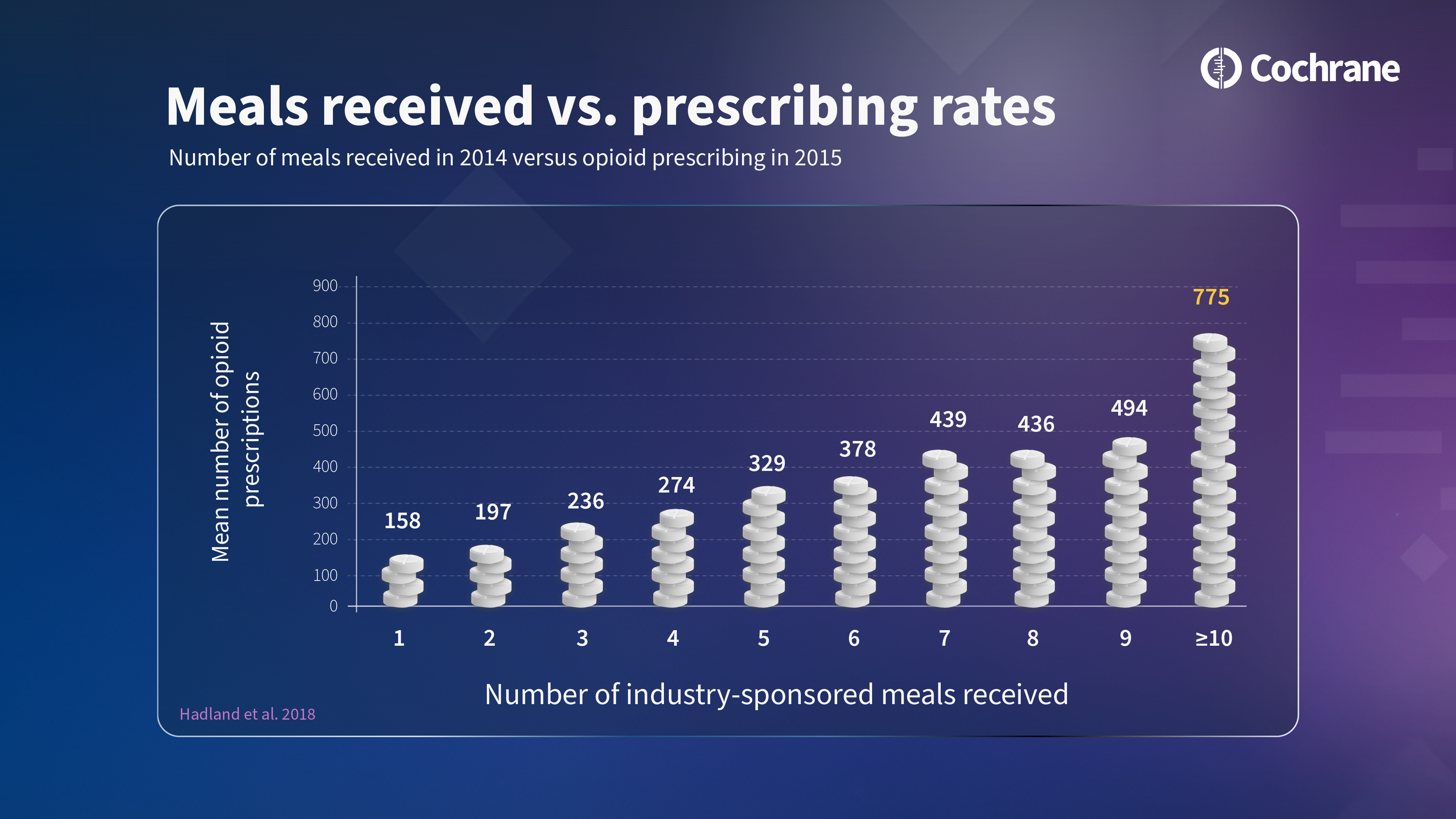
The overprescription of opioids is the most infamous example of pharmaceutical companies’ promotion exaggerating benefits and minimizing harms. This review found that even inexpensive meals increased opioid prescribing and that the more payments a doctor received from opioid manufacturers, the more likely they were to prescribe dangerously high opioid doses. The widespread inappropriate overprescribing of opioids has led to an epidemic of addiction and deaths from overdoses.
“Patients should be offered the most appropriate treatment for their condition, based on clinical evidence not industry marketing,” adds Dr Bero. “The opioid crisis in North America was perhaps the most egregious example of inappropriate over-prescribing, but this was not an isolated incident. It was high-profile due to the significant harms involved, but the systems that enabled it are unfortunately considered business-as-usual within the industry. Interactions between pharmaceutical companies and prescribing physicians are widespread, and the harms they cause are rarely so visible.”
More meals paid for, more drugs prescribe
Notably, the research shows a clear dose-response relationship between paid-for meals and inappropriate prescriptions. The more meals a doctor received from a company, the more of the company's drug they prescribed. This was true for a range of different types of drugs, from drugs for high blood pressure and cholesterol to antidepressants and opioid painkillers.
The authors also point out that this practice is seen as normal and unproblematic in the medical field.
“It's very common for doctors to receive free meals from companies,” says lead author, Dr Barbara Mintzes from the University of Sydney, Australia. “Doctors often think that this is trivial and doesn’t influence them, that they ‘can’t be bought for the price of a sandwich’, but the data shows this is an effective marketing strategy. The more free meals a doctor receives, the more likely they are to prescribe less appropriate or more expensive drugs.”
Restricting industry interactions may improve prescribing
Some hospitals and medical centres have rules or institutional restrictions in place, also known as conflict-of-interest policies, to limit how much contact industry reps can have with doctors or what gifts or samples they are allowed to provide. The review found that these can mitigate the negative impact of pharma strategies on doctors’ prescribing habits.
It’s encouraging to see that robust conflict-of-interest policies in place tended to be effective. The data shows that they probably improve prescribing appropriateness and possibly reduce the number of prescriptions.
– Dr Barbara Mintzes, University of Sydney
While this review found that drug promotion negatively influences prescribing within a broad range of drugs and clinical settings, the authors wish to emphasize that this is not about a few "bad apples”, but about improving the system and a key positive finding is that strict conflict-of-interest policies are a way forward.


