
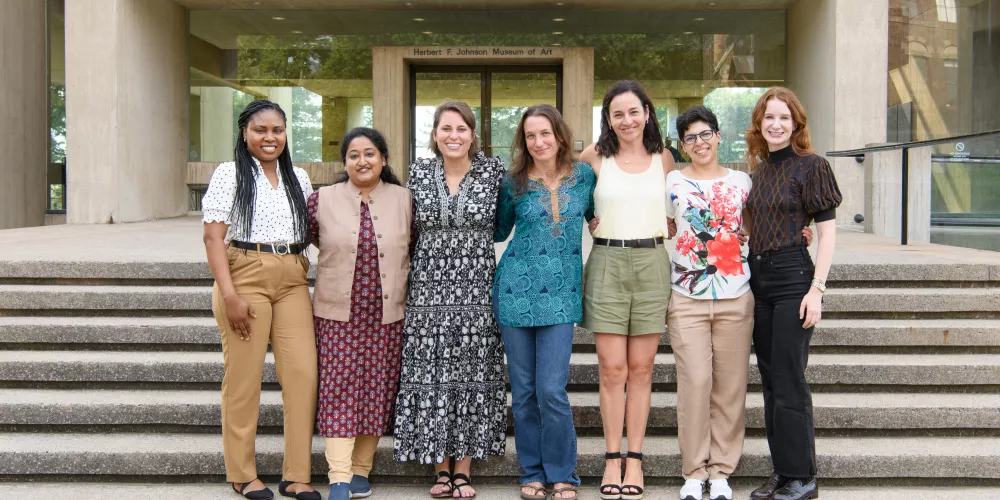
For more than a century, women at Cornell have been pioneering advances in evidence-based science, nutrition, and health. Julia Finkelstein describes why she is proud of this legacy and how this has inspired her to mentor the next generation of leaders in the field.
Over a century ago, Cornell University’s College of Human Ecology was founded by women, to provide education for women, to improve the health of women. At its origin were two trailblazing women: Flora Rose (nutrition) and Martha Van Rensselaer (home economics).
Today, Cornell is home to the Cornell Joan Klein Jacobs Center for Precision Nutrition and Health, which is named for another trailblazing woman and Cornellian who dedicated her life and legacy to improving health. The Jacobs Center is also home to the associate Cochrane Center, the PAHO/World Health Organization Collaborating Centre, and the WHO/Cochrane/Cornell Institute, which has trained more than 300 health‑care professionals in Cochrane methods over the past decade. Through this collaborative work, we focus on the synthesis and translation of evidence to inform clinical and WHO guidelines that impact the health of millions of women and girls around the world.
My journey in Cochrane
As Director of the Cornell Cochrane Center, I stand on the shoulders of the extraordinary women who came before me. Every step of my journey in Cochrane – from the first Cochrane review I participated in, the first review I anchored and led, the first time I served on a WHO guidelines meeting informed by Cochrane evidence, to my first summer directing the Cochrane Institute – has been made possible by extraordinary women mentors, who opened the door for me and inspired me to walk through.
Carrying the legacy forward
Through Cochrane and in my roles as a mentor, professor, and researcher, I am deeply committed to training the next generation of leaders in nutrition and women’s health, particularly in low‑ and middle‑income countries (LMICs). We need to ensure that the populations that we serve have a seat at the table – that we have representation and input on the generation and synthesis of evidence that informs guidelines that directly impact the health of our communities.
Training emerging leaders in evidence synthesis and supporting the cadre of researchers, scientists, health care practitioners, epidemiologists and policymakers everywhere helps to ensure that the Cochrane reviews that we develop address critical research gaps, account for local and contextual factors, and ensure that global and national guidelines are relevant and have the greatest impact.
Building on more than a decade of collaboration with Cochrane and WHO, and our WHO/Cochrane/Cornell Institute in Ithaca NY, we are expanding Cochrane trainings to reach multiple WHO regions, starting with PAHO and SEARO in 2026 and 2027 - bringing Cochrane methods and training opportunities to scholars in LMICs. We are working closely with local and regional partners on reverse translation, ensuring that the Cochrane reviews we focus on can directly inform the guidelines and policies most urgently needed for communities we serve. This is essential as we navigate both enduring challenges and emerging threats to health globally.
Beyond the science, mentorship, and leadership, working with extraordinary women in science has been the honor and highlight of my career to date.
Beyond the science, mentorship, and leadership, working with extraordinary women in science has been the honor and highlight of my career to date. I have had the privilege of working with dozens of extraordinary women on Cochrane reviews and over 250 as part of our Cochrane Institute. We continue to train the next generation of leaders in the field, strengthening the pipeline of women leaders in science and improving health outcomes for women globally.
Celebrating mentorship in women in science in Cochrane
I am honored to receive this year’s The Anne Anderson award from Cochrane. Dr. Anderson was a pioneer in reproductive physiology, evidence-based medicine, and women’s health. Cochrane’s Anne Anderson Award is given for significant contributions to the promotion of women as leaders and contributors to Cochrane, and to enhancement and visibility of women's participation within Cochrane.
One of the most incredible parts of this award is that it includes an opportunity to identify an outstanding mentee to honor and share the award. I would not be here without the women who brought me into Cochrane, and I would not be here without the outstanding women I have had the privilege of mentoring.
I would not be here without the women who brought me into Cochrane, and I would not be here without the outstanding women I have had the privilege of mentoring.
I am delighted to recognize my mentee and colleague, Dra. Elizabeth Centeno Tablante, and to share this award with her. Over the past decade, Elizabeth has been integral to my Cochrane journey – we first met when she participated in our Cochrane Institute (when she was at WHO) and we recruited her to our Ph.D. program here at Cornell. We have co-authored Cochrane reviews together to inform WHO guidelines, and we welcomed her to the WHO/Cochrane/Cornell Institute last year as a faculty member. Elizabeth is a rising star in evidence synthesis, nutrition, and women’s health, and I could not imagine a more deserving partner to share this award!
Thank you, Cochrane, for the opportunity to pay this forward, and for all that you do to support evidence, mentorship and leadership of women in science. At Cornell, we have a longstanding commitment to women in science – and to women’s health.
As we reflect on pioneering women in science, and leaders in the field of nutrition and women’s health, I am humbled by those who blazed the trail before me and inspired me to continue this critical work. Science thrives on innovation, and we all benefit when women and girls are leading the way.
If you'd like to hear more from Julia, sign up for our panel discussion


