Image

The work of healthcare professionals (e.g. nurses, physicians, psychologists, social workers) can be very stressful. They often carry a lot of responsibility and are required to work under pressure. This can adversely affect their physical and mental health. Interventions to protect them against such stresses are known as resilience interventions. Previous systematic reviews suggest that resilience interventions can help workers cope with stress and protect them against adverse consequences for their physical and mental health.
Image
Cochrane review authors asked, “do psychological interventions designed to foster resilience improve resilience, mental health and other factors associated with resilience in healthcare professionals?” This question is particularly relevant at the moment, when healthcare workers are under great pressure due to COVID-19.
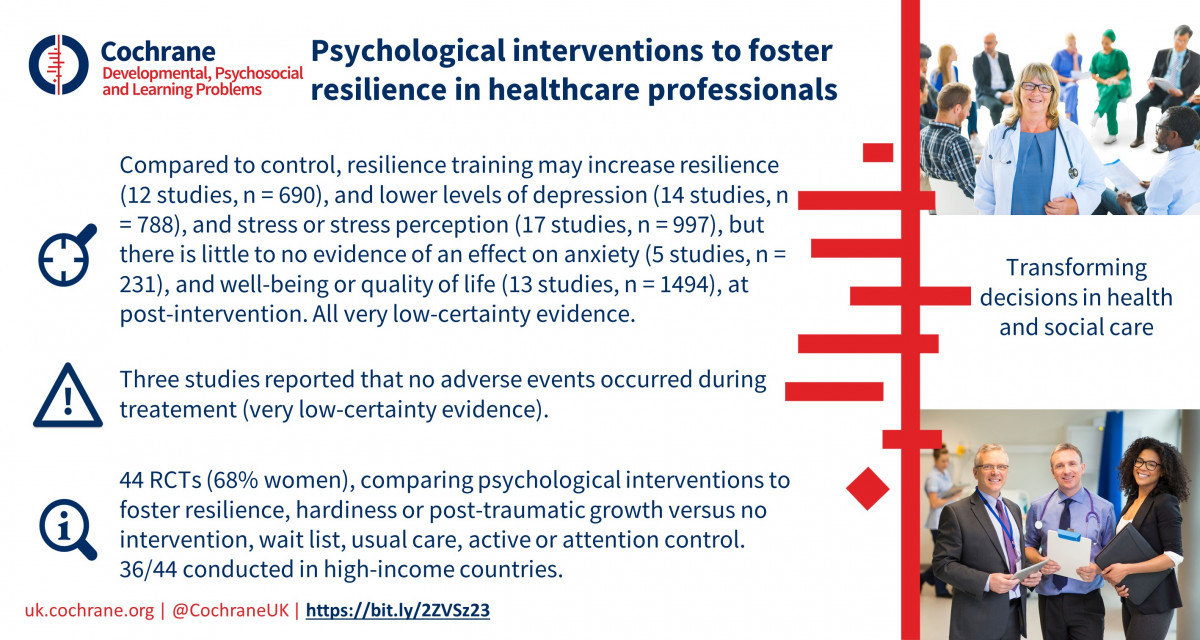
Review authors searched for studies up to June 2019. They found 44 studies that tested a range of resilience interventions. Thirty-nine studies included healthcare professionals only (6892 participants). Four studies included healthcare professionals and non‐healthcare workers (1000 participants). The remaining study examined 82 volunteer emergency workers.
Nineteen studies compared a combined resilience intervention (e.g. mindfulness and cognitive‐behavioural therapy) with unspecific comparators (e.g. a wait‐list control). Most interventions were performed in face-to-face, in groups, with high training intensity of more than 12 hours or sessions.
The review authors found very low-certainty evidence that resilience training may improve resilience in healthcare professionals, and may reduce symptoms of depression and stress immediately after the end of treatment. Resilience interventions do not appear to reduce anxiety symptoms or improve well‐being. Very few studies reported on the longer‐term impact of resilience interventions. Only three studies examined potential adverse events and found no undesired effects.
Image
Studies used a variety of different outcome measures and intervention designs, making it difficult for the review authors to draw general conclusions from the findings. The evidence that they found in this review is limited and very uncertain. This means that, at present, the review authors have very little confidence that resilience interventions make a difference to healthcare workers’ resilience.
The review authors will include results of an updated search of four key databases carried out in June 2020 when they update their review.
Image