
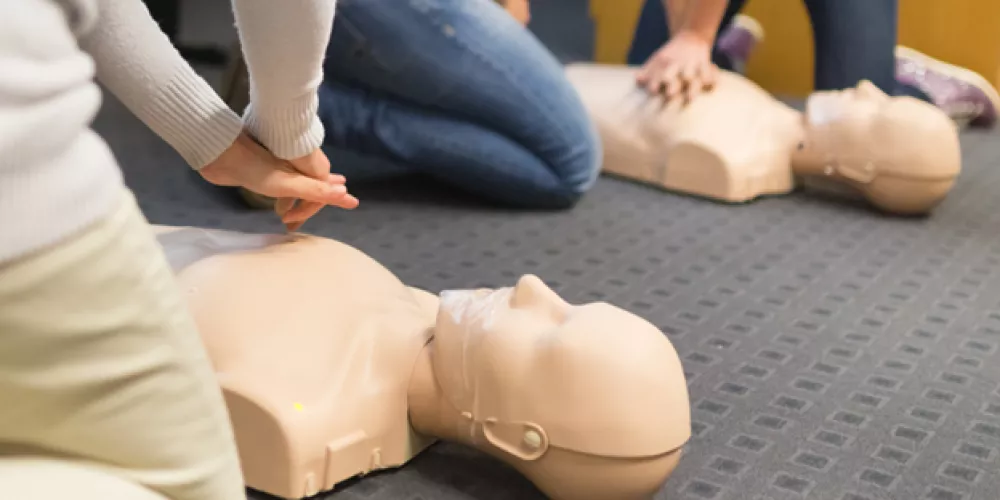
When someone gets injured or collapses in a public place, the first person to help is rarely a medical professional. It’s a colleague, a friend, a passerby. First aid training for laypeople is promoted around the world, but is it effective?
This question matters to people and organizations worldwide. So, researchers from Cochrane First Aid and the Centre for Evidence-Based Practice (CEBaP) of Belgian Red Cross-Flanders have produced a Cochrane review providing some answers. Discover how the review came about, what it found and what this could mean in practice.
How was this issue identified?
CEBaP is a research centre that supports the activities of the Belgian Red Cross-Flanders, including first aid training, a core activity of the 191 Red Cross and Red Crescent Societies worldwide. Back in 2019, CEBaP launched Cochrane First Aid to highlight the role of laypeople as providers of health interventions. This is especially important in low- and middle-income countries, where professional healthcare is not always readily available or accessible.
In 2020 and 2021, Cochrane First Aid performed a three-stage prioritization exercise. They involved a range of stakeholders – from lay first aid providers, to first aid trainers and guideline developers. Together they generated a list of priority topics for new Cochrane reviews. The question “Is first aid education effective?” ranked second.
“We reviewed previous prioritization exercises, surveyed a broad group of stakeholders, and finally specifically consulted stakeholders from low- and middle-income countries” - Jorien Laermans, CEBaP Researcher and Coordinator of Cochrane First Aid (second review author)
Turning questions into evidence
This is where Irvin Kendall came in. Irvin joined CEBaP as a Junior Researcher and is working on a PhD aiming to strengthen the scientific evidence base for context-specific first aid training in low- and middle-income countries. As part of this, he undertook a systematic review to try and answer the question of whether first aid training for laypeople is effective.
“First aid training is widely promoted around the world, but its actual impact in real emergency situations remains unclear” - Irvin Kendall, PhD student at CEBaP (first review author)
And it wasn’t just identifying the question that involved stakeholders, the protocol and the review itself were also developed in close collaboration with stakeholders. This included working with Cochrane First Aid, Belgian Red Cross-Flanders and experts from organizations like the International Federation of Red Cross and Red Crescent Societies (IFRC) and the International Liaison Committee on Resuscitation.
“I think we did a pretty decent job involving a wide variety of stakeholders, not only during the prioritization process, but also while conducting the review. Of course, there’s always room for improvement.” - Jorien Laermans
What did the review tell us?
The review analyzed 36 studies with over 15,000 participants. Half of the studies were conducted in the USA and only five in low- and middle-income countries. The team found that:
- First aid training likely improves knowledge, skills, and self-efficacy in the month following training.
- The longer-term effects are unclear. In addition, there’s insufficient evidence to say whether these gains translate into improved helping behaviour, higher quality of care, or better health outcomes for those receiving first aid.
- There is a need for more rigorous research on the real-world effectiveness of first aid training, particularly in low- and middle-income countries, to support effective training design and inform policy decisions.
“While we can’t yet pinpoint the most effective training methods, the evidence supports the provision of first aid training to improve laypeople’s knowledge, skills, and confidence to act in emergency situations” - Irvin Kendall
What research is needed further?
So, what does this mean for the future of first aid training? While current research focuses on learning outcomes – such as knowledge, skills, self-efficacy, and willingness to help – future research should focus on the effect of training in real-life emergency situations.
In addition, the first aid community needs to agree on core outcomes and standard tools to measure success, making future research more comparable and actionable. Finally, more research needs to be conducted in low- and middle-income countries, where it is most needed.
“It surprised us how the different studies included in the review all applied different training methods, measured the outcomes in different ways, and measured them at a variety of time points. It makes comparisons difficult.” - Irvin Kendall
Making the evidence accessible
Cochrane First Aid is committed to ensuring that this, and all, research doesn’t just sit on a shelf. They’ve created accessible summaries and infographics in multiple languages to help spread the messages of this review, and later this year they’ll be publishing a two-page summary and visual abstract in the International Journal of First Aid Education.
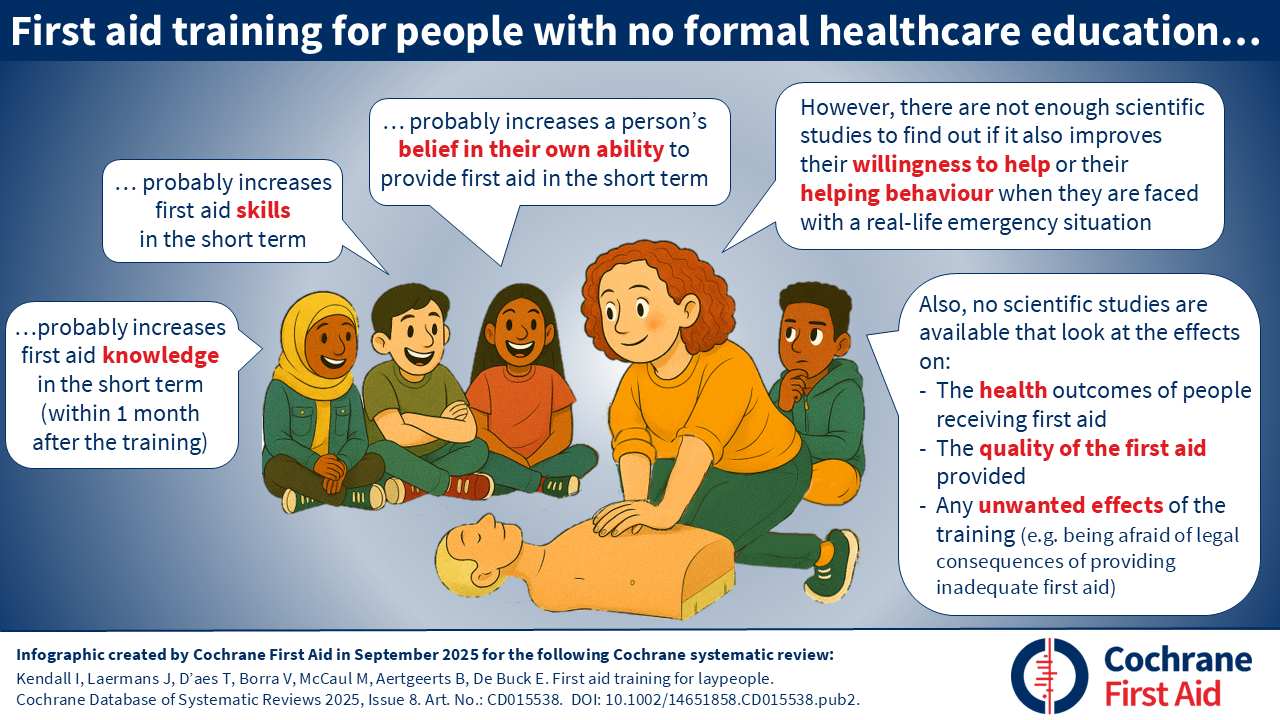
On top of all this, they are also working closely with guideline developers to ensure the latest evidence informs practice worldwide. For example, the review will be referenced in the upcoming updated IFRC International First Aid, Resuscitation, and Education Guidelines.
With an eye on improving stakeholder engagement in the future, the team are also setting up a panel of patients and members of the public with interest in health evidence as part of the Cochrane Acute and Emergency Care Thematic Group. They hope this panel can support them in producing and sharing relevant Cochrane reviews making sure that evidence is relevant, accessible and impactful.
Why this matters
This review was shaped by the people who needed it – from identifying the question to developing the protocol and sharing the review findings. This work from Cochrane First Aid and CEBaP highlights that we need to involve and inform all relevant stakeholders – in this case: researchers, trainers, guideline developers, policymakers, and the public. Because so often in first aid, it’s ordinary people that are put to the test.
Want to learn more?


