
Why is this question important?
Babies born prematurely (before 37 weeks of pregnancy) can have trouble breathing if their lungs are not sufficiently developed. Up to half of babies born before 28 weeks, and a third of babies born before 32 weeks, have problems breathing and many babies do not survive. Others may become disabled due to the lack of oxygen they suffer because of the breathing difficulties experienced at birth.
Women who may be at risk of giving birth prematurely can be given corticosteroids to prevent their babies from having trouble breathing once they are born. Corticosteroids are anti-inflammation medicines that help the baby’s lungs mature before being born. They are usually given to women at risk of early labour, typically as two injections, though they can also be given before planned preterm birth and in some cases a repeat course can be given.
To find out about the benefits and risks of giving corticosteroids to women at risk of giving birth early, we reviewed the evidence from research studies.
How did we identify and evaluate the evidence?
We searched the medical literature for studies that compared the effects of corticosteroids against:
- a placebo (dummy) treatment; or
- no treatment.
We compared the results and summarised the evidence from all the studies. We rated our confidence in the evidence, based on factors such as study methods and sizes, and the consistency of findings across studies.
What did we find?
We found 27 studies that involved 11,272 women and 11,925 infants. The studies were set in 21 different countries, which included high-, middle- and low-income countries.
Infant health
Robust evidence shows that corticosteroids:
- reduce perinatal deaths (numbers of stillbirths and babies dying in the first 28 days of life);
- reduce neonatal deaths (numbers of babies dying in the first 28 days of life);
- reduce serious breathing problems in the first hours of life;
- have little to no effect on babies’ birth weight.
Corticosteroids probably reduce the risk of:
- bleeding inside the brain;
- developmental delay in later childhood.
We are only moderately confident about these two findings, either because:
- the infants in the studies may not have been representative of all babies born prematurely; or
- studies may have been conducted in ways that introduced errors into their results.
Maternal health
The evidence indicates that corticosteroids probably do not affect the risk of:
- mothers dying after giving birth;
- developing chorioamnionitis (inflammation or infection of the tissues that surround the baby in pregnancy);
- developing endometritis (inflammation of the lining of the uterus).
We are only moderately confident about these three findings because they are based on few events. Until we have more evidence from more women, we cannot be certain that there is no difference in risk.
We found little evidence about:
- women who were pregnant with multiple babies; women with high blood pressure; or women whose membranes surrounding the baby broke early;
- the effects of corticosteroids in babies born prematurely versus very prematurely;
- different doses of corticosteroids.
This means that we cannot be certain that the findings in this review apply to all women and babies at risk of premature birth. Nor can we determine which dose of corticosteroids is best.
What does this mean?
Corticosteroids given to women at risk of premature birth improve the chances that, once they are born, their babies will be able to breathe and survive.
The evidence available suggests that corticosteroids are probably not associated with risks for the baby or mother. Further evidence is needed about:
- whether corticosteroids work differently for women who expect multiple babies or who have high blood pressure;
- whether the benefits and risks of corticosteroids are the same when babies are born very prematurely, or less prematurely;
- which dose of corticosteroids works best.
How-up-to date is this review?
The evidence in this Cochrane Review is current to September 2020.
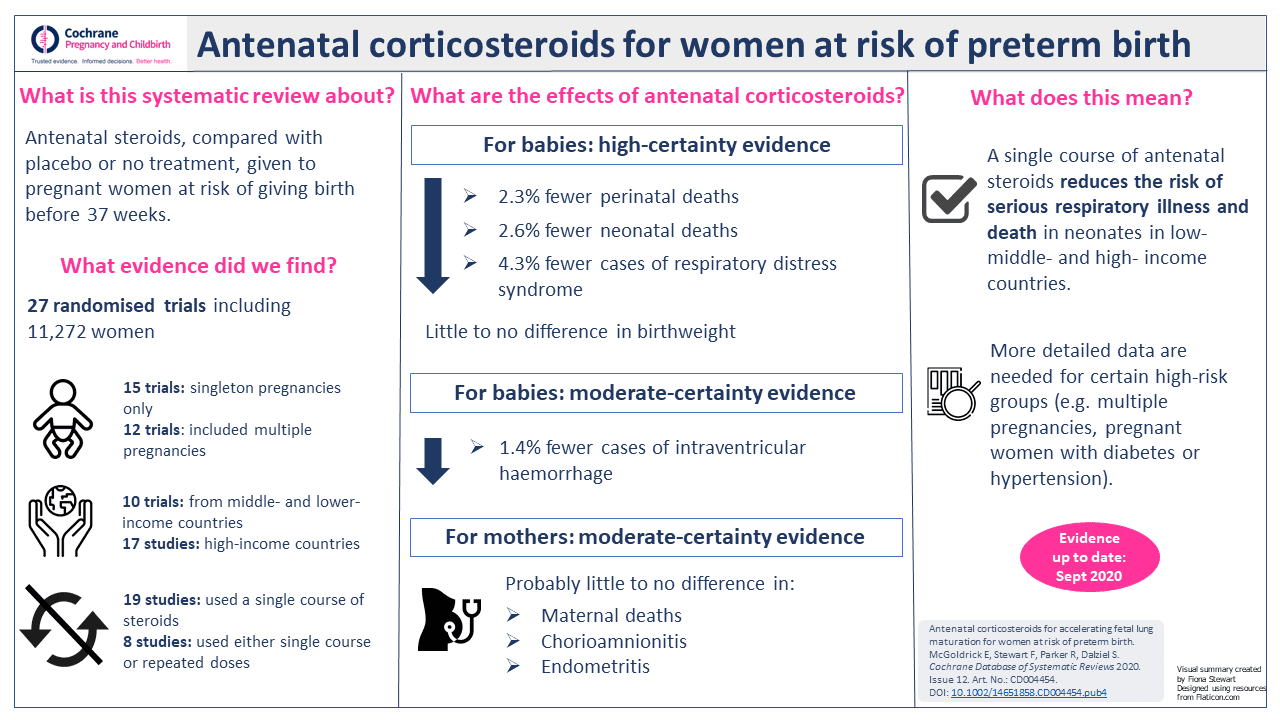
A visual summary of some of the results from this review can be found here.
Evidence from this updated review supports the continued use of a single course of antenatal corticosteroids to accelerate fetal lung maturation in women at risk of preterm birth. Treatment with antenatal corticosteroids reduces the risk of perinatal death, neonatal death and RDS and probably reduces the risk of IVH. This evidence is robust, regardless of resource setting (high, middle or low).
Further research should focus on variations in the treatment regimen, effectiveness of the intervention in specific understudied subgroups such as multiple pregnancies and other high-risk obstetric groups, and the risks and benefits in the very early or very late preterm periods. Additionally, outcomes from existing trials with follow-up into childhood and adulthood are needed in order to investigate any longer-term effects of antenatal corticosteroids.
We encourage authors of previous studies to provide further information which may answer any remaining questions about the use of antenatal corticosteroids without the need for further randomised controlled trials. Individual patient data meta-analyses from published trials are likely to provide answers for most of the remaining clinical uncertainties.
Respiratory morbidity including respiratory distress syndrome (RDS) is a serious complication of preterm birth and the primary cause of early neonatal mortality and disability. Despite early evidence indicating a beneficial effect of antenatal corticosteroids on fetal lung maturation and widespread recommendations to use this treatment in women at risk of preterm delivery, some uncertainty remains about their effectiveness particularly with regard to their use in lower-resource settings, different gestational ages and high-risk obstetric groups such as women with hypertension or multiple pregnancies.
This updated review (which supersedes an earlier review Crowley 1996) was first published in 2006 and subsequently updated in 2017.
To assess the effects of administering a course of corticosteroids to women prior to anticipated preterm birth (before 37 weeks of pregnancy) on fetal and neonatal morbidity and mortality, maternal mortality and morbidity, and on the child in later life.
We searched the Cochrane Pregnancy and Childbirth Group's Trials Register (3 September 2020), ClinicalTrials.gov, the databases that contribute to the WHO International Clinical Trials Registry Platform (ICTRP) (3 September 2020), and reference lists of the retrieved studies.
We considered all randomised controlled comparisons of antenatal corticosteroid administration with placebo, or with no treatment, given to women with a singleton or multiple pregnancy, prior to anticipated preterm delivery (elective, or following rupture of membranes or spontaneous labour), regardless of other co-morbidity, for inclusion in this review.
We used standard Cochrane Pregnancy and Childbirth methods for data collection and analysis. Two review authors independently assessed trials for inclusion, assessed risk of bias, evaluated trustworthiness based on predefined criteria developed by Cochrane Pregnancy and Childbirth, extracted data and checked them for accuracy, and assessed the certainty of the evidence using the GRADE approach. Primary outcomes included perinatal death, neonatal death, RDS, intraventricular haemorrhage (IVH), birthweight, developmental delay in childhood and maternal death.
We included 27 studies (11,272 randomised women and 11,925 neonates) from 20 countries. Ten trials (4422 randomised women) took place in lower- or middle-resource settings.
We removed six trials from the analysis that were included in the previous version of the review; this review only includes trials that meet our pre-defined trustworthiness criteria. In 19 trials the women received a single course of steroids. In the remaining eight trials repeated courses may have been prescribed.
Fifteen trials were judged to be at low risk of bias, two had a high risk of bias in two or more domains and ten trials had a high risk of bias due to lack of blinding (placebo was not used in the control arm.
Overall, the certainty of evidence was moderate to high, but it was downgraded for IVH due to indirectness; for developmental delay due to risk of bias and for maternal adverse outcomes (death, chorioamnionitis and endometritis) due to imprecision.
Neonatal/child outcomes
Antenatal corticosteroids reduce the risk of:
- perinatal death (risk ratio (RR) 0.85, 95% confidence interval (CI) 0.77 to 0.93; 9833 infants; 14 studies; high-certainty evidence; 2.3% fewer, 95% CI 1.1% to 3.6% fewer),
- neonatal death (RR 0.78, 95% CI 0.70 to 0.87; 10,609 infants; 22 studies; high-certainty evidence; 2.6% fewer, 95% CI 1.5% to 3.6% fewer),
- respiratory distress syndrome (RR 0.71, 95% CI 0.65 to 0.78; 11,183 infants; studies = 26; high-certainty evidence; 4.3% fewer, 95% CI 3.2% to 5.2% fewer).
Antenatal corticosteroids probably reduce the risk of IVH (RR 0.58, 95% CI 0.45 to 0.75; 8475 infants; 12 studies; moderate-certainty evidence; 1.4% fewer, 95% CI 0.8% to1.8% fewer), and probably have little to no effect on birthweight (mean difference (MD) -14.02 g, 95% CI -33.79 to 5.76; 9551 infants; 19 studies; high-certainty evidence).
Antenatal corticosteroids probably lead to a reduction in developmental delay in childhood (RR 0.51, 95% CI 0.27 to 0.97; 600 children; 3 studies; moderate-certainty evidence; 3.8% fewer, 95% CI 0.2% to 5.7% fewer).
Maternal outcomes
Antenatal corticosteroids probably result in little to no difference in maternal death (RR 1.19, 95% CI 0.36 to 3.89; 6244 women; 6 studies; moderate-certainty evidence; 0.0% fewer, 95% CI 0.1% fewer to 0.5% more), chorioamnionitis (RR 0.86, 95% CI 0.69 to 1.08; 8374 women; 15 studies; moderate-certainty evidence; 0.5% fewer, 95% CI 1.1% fewer to 0.3% more), and endometritis (RR 1.14, 95% CI 0.82 to 1.58; 6764 women; 10 studies; moderate-certainty; 0.3% more, 95% CI 0.3% fewer to 1.1% more)
The wide 95% CIs in all of these outcomes include possible benefit and possible harm.